
Thermal Management & Heat Transfer
Cabin Comfort & HVAC Thermal Simulation
Optimize Cabin Comfort Across Real Driving Conditions
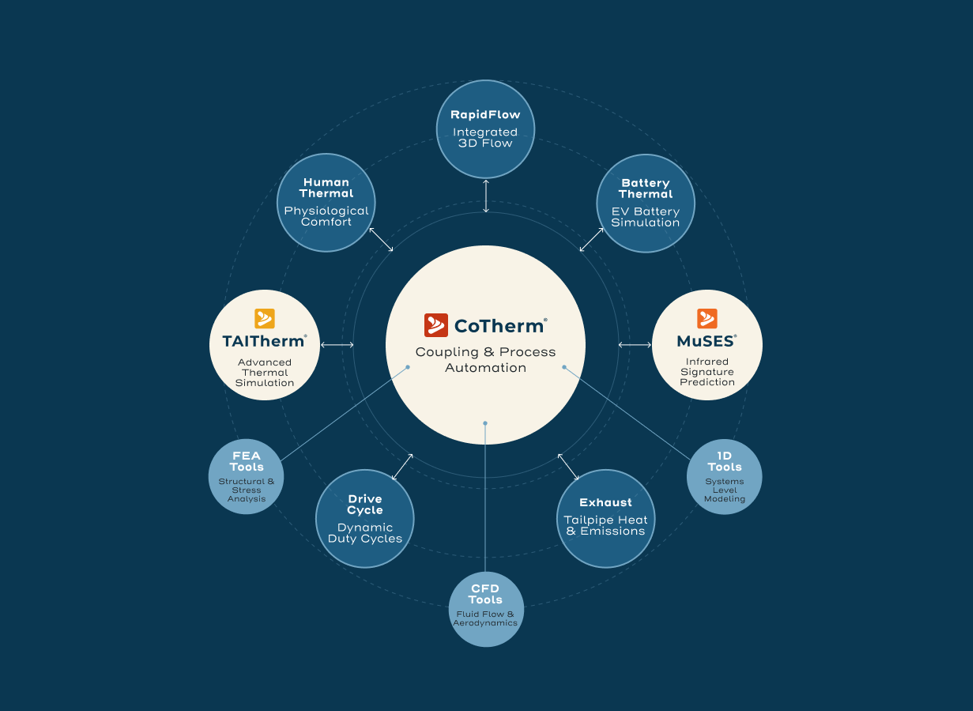
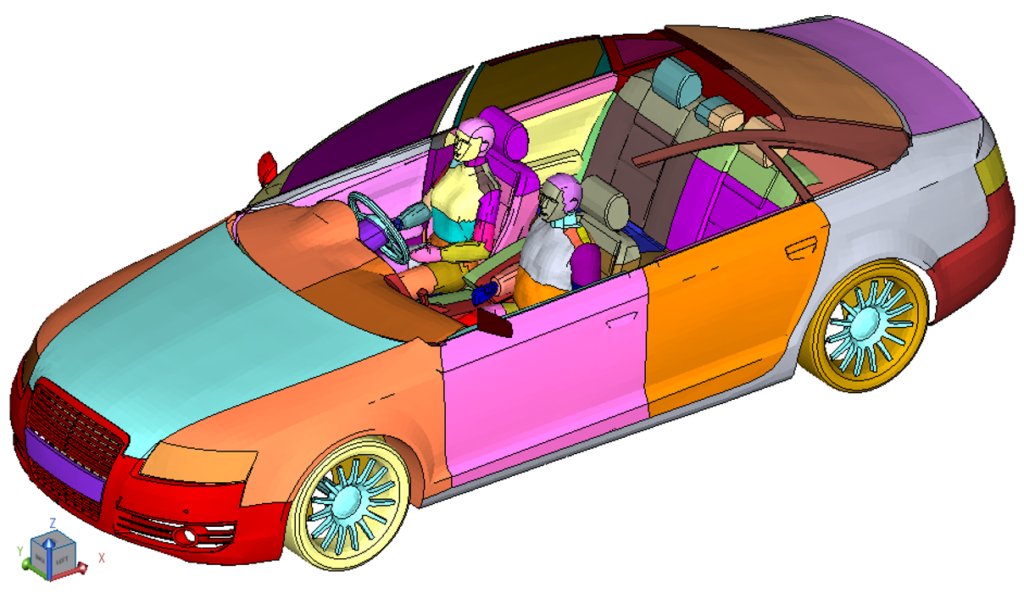
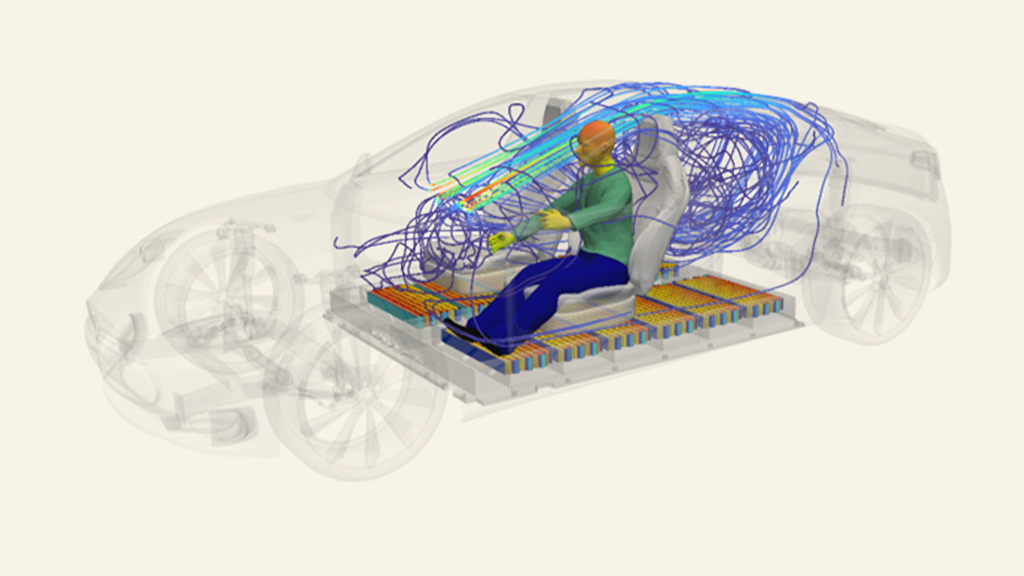
Achieving optimal cabin comfort while maintaining vehicle efficiency is a complex balancing act of physics. Engineers must account for transient environmental loads, complex glazing radiation, and the intricate physiological responses of human occupants. ThermoAnalytics provides a complete ecosystem to solve these challenges, centering on TAITherm for high-fidelity thermal analysis, CoTherm for seamless multiphysics coupling, the Human Thermal Extension (HTE) for industry-leading physiological modeling, and RapidFlow for 3D convection and fluid simulation.
By integrating these tools, OEMs can shift from air temperature targets to true human comfort metrics, drastically reducing physical prototyping cycles, extending EV range through HVAC optimization, and ensuring occupant comfort in extreme environments.
How It Works:
The Science of Comfort
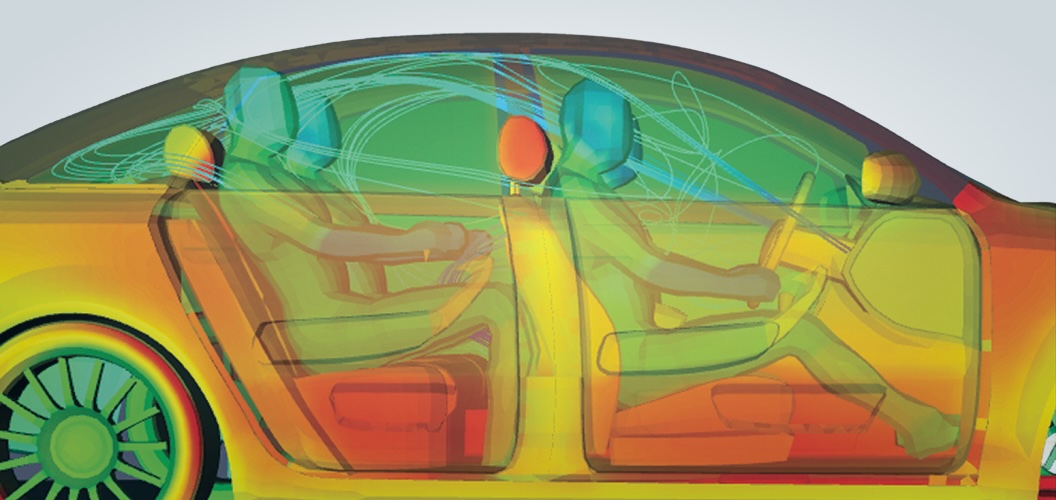
ThermoAnalytics’ approach replaces steady-state approximations with high-fidelity transient simulation. Our workflow captures the time-varying thermal journey of a vehicle for any desired pre-conditioning and operational scenario, such as a high-intensity solar soak in the desert to a transient cool-down with maximum AC.
Transient Heat Transfer & Radiation Exchange
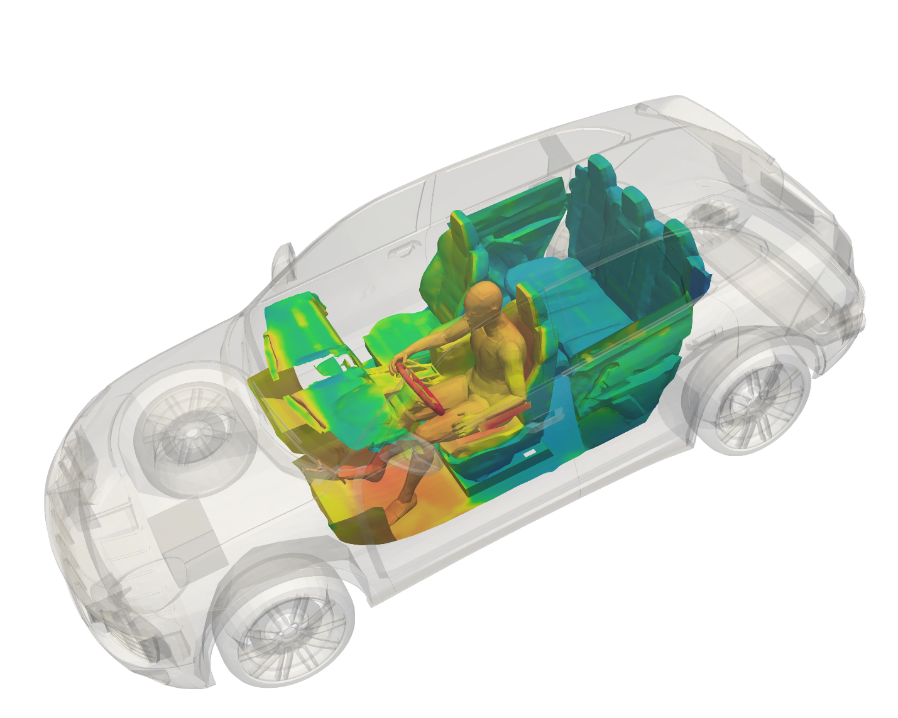
At the core of the cabin model is the TAITherm solver, which calculates conduction, convection, and radiation simultaneously. TAITherm utilizes a dual-band radiation model to account for solar transmission through glazing and the complex surface-to-surface radiation of heat from interior surfaces like dashboards and seats. The solver accounts for:
Spectral Glazing Properties
Modeling how IR-reflective coatings and glass thickness impact heat gain.
Surface-to-Surface Radiation
Using high-resolution view factors to determine how heat moves between interior components.
Thermal Mass & Storage
Calculating how materials (leather, foam, plastics) store and release energy over time.

The Human Thermal Extension Integration
Rather than treating a passenger as a static “heat load” (e.g., a simple 100W imposed on a manikin surface), our Human Thermal Extension discretizes the human body into physiology segments with multiple layers representing the tissues making up each segment. Each segment features its own physiological control system, simulating:
Thermal Response to Environment
Real-time calculation of skin and core temperatures accounting for metabolic heating and all environmental heat sources and sinks.
Bio-Heat Regulation
Modeling blood flow (vasoconstriction/vasodilation) and latent heat loss through sweating and respiration.
Clothing Insulation
Accounting for the thermal resistance and moisture permeability of different apparel sets.
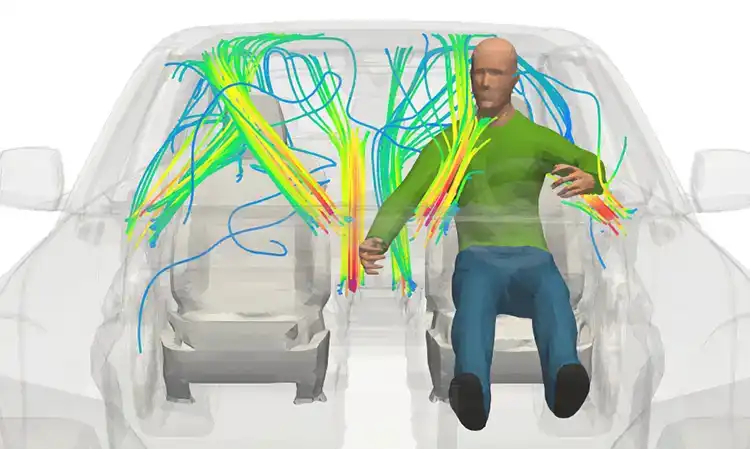
Efficient 3D flow modeling via RapidFlow
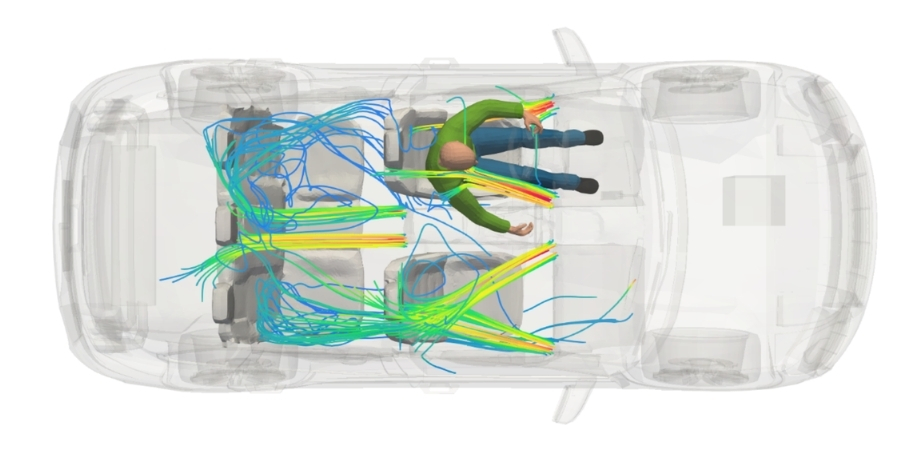
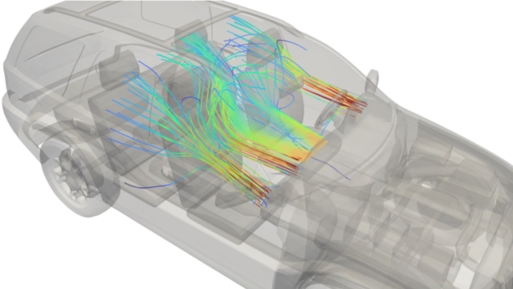
When full CFD is too computationally expensive, RapidFlow can be used within the TAITherm environment. It generates a 3D physics-based flow field that is coupled to the thermal solver, allowing for dozens of design iterations in the time it would take to run a single CFD transient. This approach is particularly valuable for rapid exploration of early-stage design details.
Automatic fluid domain meshing
Include one or multiple fluid domains defined from standard TAITherm thermal geometry, with flow inlet and outlet locations chosen based on thermal parting.
Seamless thermal-fluid coupling
RapidFlow domains are automatically coupled at TAITherm’s runtime with flexible controls for steady or transient scenarios
Model forced or natural convection
RapidFlow’s turbulence and buoyancy models and flexible discretization are useful for precondition soak simulations and transient pull-downs.
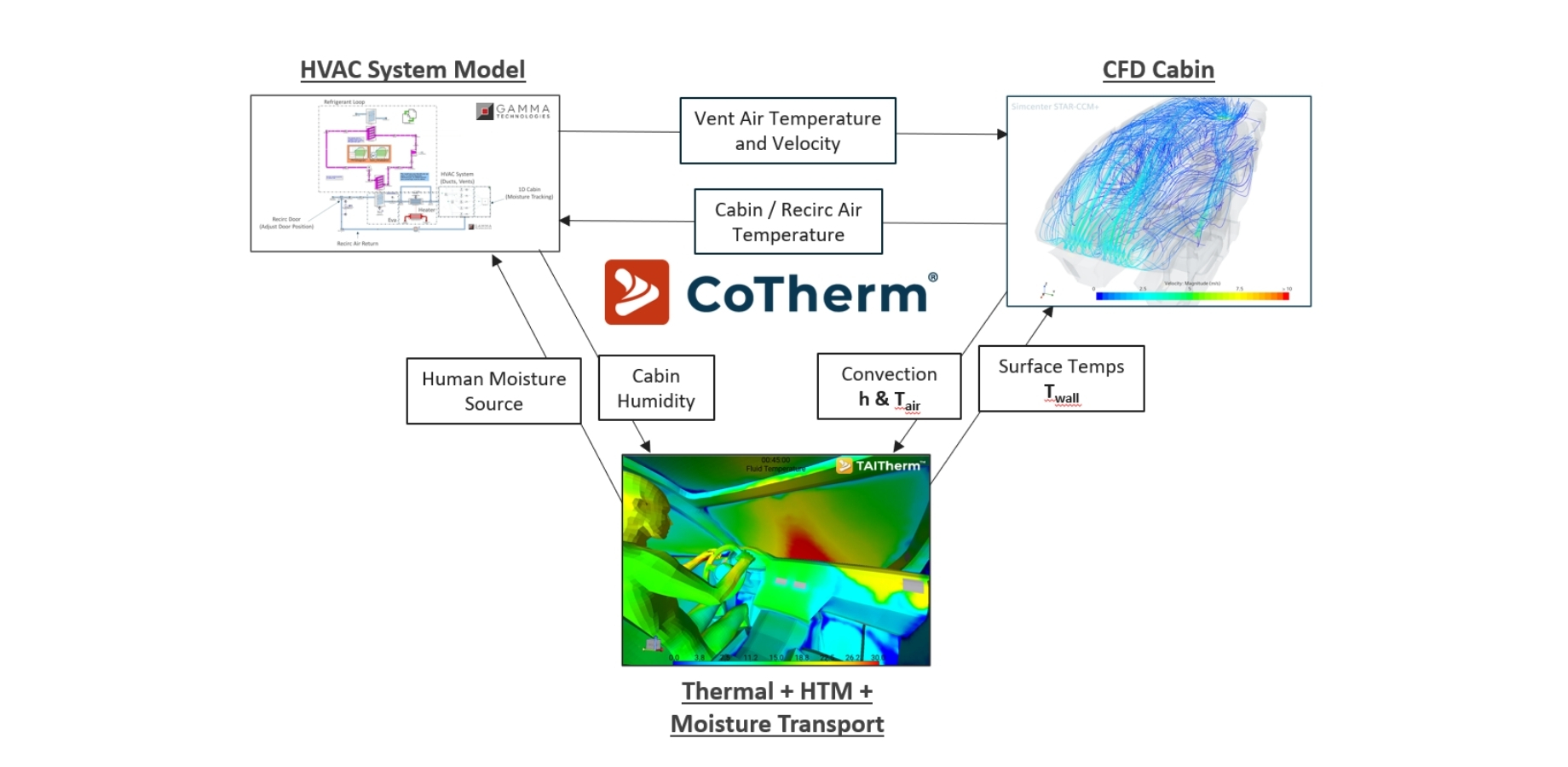
Multi-Physics Coupling via CoTherm
To achieve a “closed-loop” simulation, CoTherm acts as the orchestration layer between TAITherm’s thermal and human solutions and other multi-physics simulations such as CFD or system models.
Fluid-Thermal Coupling
CoTherm automates the exchange of data between TAITherm and 3rd-party CFD solvers. It maps the fluid temperatures and convection coefficients onto the thermal mesh and returns updated surface temperatures to the CFD solver.
Control Logic Integration
The workflow supports direct integration of control algorithm models, where the HVAC controller can adjust fan speeds or vent temperatures based on the simulated human comfort metrics.
Electronics Thermal Analysis
For high-performance computing, automotive auxiliary electronics, and telecommunications, CoTherm manages the coupling between thermal, fluid, and power-draw models.
Dynamic Workload Analysis
Coordinates realistic duty cycles, such as how a CPU/GPU “burst” of activity creates transient heat that the cooling system must mitigate.
Material Stack-Up Study
CoTherm’s automation of design sweeps pairs with TAITherm’s powerful multilayer modeling and thermal linking capabilities to easily study the thermal impact of different chip layout, cooling device, or TIM (Thermal Interface Material) choices across a design space.
Environmental Influence Considerations
Automated workflows enable comprehensive studies of how external ambient changes affect the internal operating temperature of electronics enclosures.
Engineering Without Compromise
By integrating ThermoAnalytics into your design workflow, you transform thermal management from a reactive fix into a competitive advantage.
Human Physiology & Thermal Sensation
Go beyond simple temperature readings to understand the actual human experience. The Human Thermal Extension models the physiological responses of occupants against transient environmental changes. By modeling the human body as a complex thermal system rather than a static point, you can accurately predict comfort levels for any scenario and design change, ensuring designs meet the highest standards for occupant well-being.
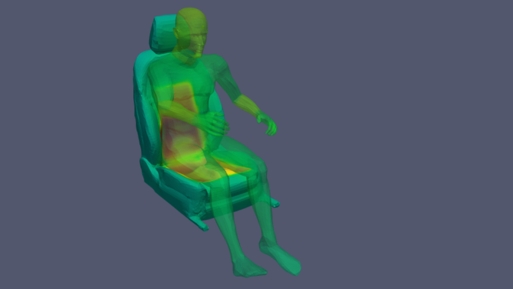
HVAC Vent Placement and Design
HVAC vent placement and design is the foundation of a premium, climate-controlled environment. By leveraging simulation early in the design phase, engineers can determine the ideal coordinates, duct geometries, and vane angles to ensure uniform air distribution while eliminating common pain points like “eye-blast” or stagnant air pockets.
Electric Vehicle Range Extension
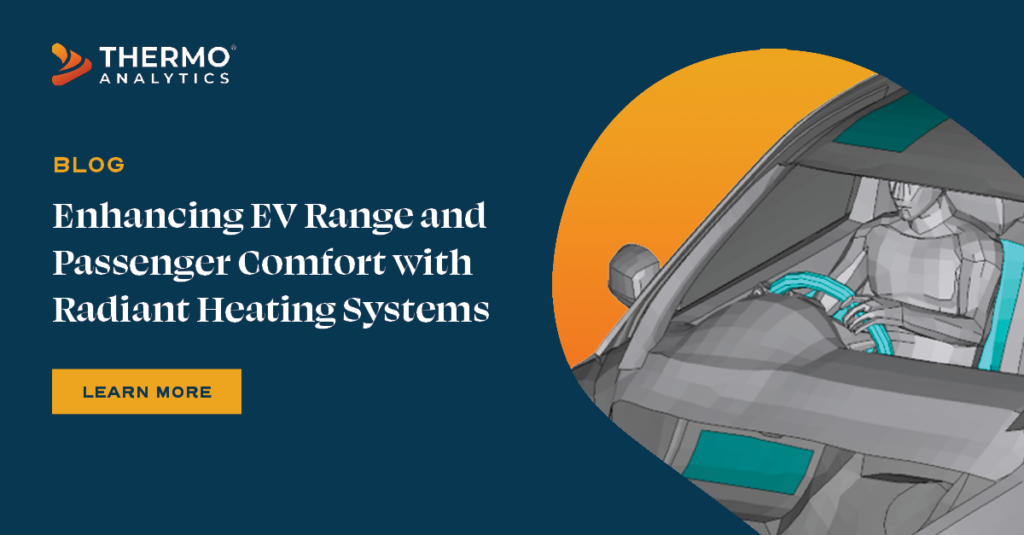
In the era of electrification, the HVAC system is a primary competitor for battery energy, often significantly reducing driving range during extreme weather. ThermoAnalytics addresses this “range anxiety” by shifting the focus from conditioning the entire cabin volume to high-efficiency, occupant-centric thermal management. By using TAITherm and RapidFlow to optimize the placement of vents and the integration of radiant panels and heated devices, engineers can maintain superior passenger comfort while drastically reducing the power draw on the battery.