

Integrated 3D Flow Simulation for Thermal Systems
CFD Accuracy Without the CFD Overhead
RapidFlow is an advanced 3D flow solver extension purpose-built for thermal engineers who require the accuracy of 3D airflow modeling without the overhead of general-purpose CFD. Fully integrated into TAITherm and MuSES workflows, it utilizes a solver based on simplified Navier-Stokes equations specifically tailored for convective heat transfer analysis. By focusing strictly on the physics necessary for thermal-fluid interaction, RapidFlow delivers full 3D fluid results with significantly reduced setup time, flexible mesh size, and minimal computational costs.
RapidFlow eliminates the need for building multiple models with disparate thermal and CFD tools. It bridges the gap between fast-running 0D fluid modeling and full-on CFD coupling, allowing engineers to analyze transient 3D airflow effects, such as cabin cool-down or vehicle EO-IR signature wind impacts, directly within their primary thermal environment. With RapidFlow, multidisciplinary teams can execute rapid design iterations that maintain physics-based modeling standards while meeting aggressive product development timelines.

Accelerate Simulation Speed
RapidFlow computes complex fluid interactions in seconds, allowing for real-time design iterations that would take hours or days in traditional CFD software.

Simplify Flow Modeling
The tool automates the creation of internal fluid networks, enabling users to represent intricate cooling channels and air paths without manual geometric simplification.

Optimize Cooling Systems
Engineers accurately predict mass flow rates and pressure drops to ensure pumps, fans, and heat exchangers are sized perfectly for the thermal load.

Enhance Transient Analysis
Seamless integration with 3D thermal solvers provides high-fidelity convection coefficients for time-dependent simulations, capturing realistic thermal responses during variable operation.
Advanced Capabilities for
Complex Thermal Systems
Seamless Thermal-Fluid Modeling
RapidFlow is included as an optional feature of TAITherm and MuSES software, providing an automated fluid mesh generation and coupling process that synchronizes fluid flow and heat transfer calculations. This logic eliminates the overhead of exporting and importing data between different software packages, ensuring that energy balance is maintained throughout the transient simulation. By unifying the solver environment, engineers can focus on thermal performance rather than the logistics of tool-to-tool communication.
Direct Workflow Integration
Works natively inside your thermal environment using specified geometric parts to represent one or more fluid domains and automate complex modeling tasks.
Streamlined Licensing
Reduces software costs by eliminating the need for high-end general CFD licenses for thermal tasks.
Automated Data Transfer
Seamlessly maps between fluid and thermal domains without manual user intervention.
Comprehensive Post-Processing
View thermal and convective surface results in TAITherm and detailed 3D fluid fields using automatically written EnSight case files in ParaView or other tools.

Efficient and Robust Convection Solver
The RapidFlow solver is optimized for physics-based accuracy and speed by utilizing simplified Navier-Stokes equations that prioritize airflow and heat transfer modeling. Specialized solver methods allow the software to remain stable even on coarse meshes and large timesteps that would typically cause traditional CFD codes to diverge or lose accuracy. It provides a smarter balance between computational time and accuracy, specifically for complex convective problems.
Simplified Navier-Stokes Solver
Solves for incompressible flow using a stable semi-Lagrangian advection method.
Fast-Running Turbulence Models
Optional zero-equation RANS turbulence model provides accuracy and improved convergence for turbulent flow.
Buoyancy-Driven Flow Support
Accurately captures natural convection effects in enclosed or open environments.
Coarse Mesh Stability
Maintains numerical robustness with coarse meshes needed for rapid turnaround or massive length scale cases.
Dynamic 1D/3D System Coupling
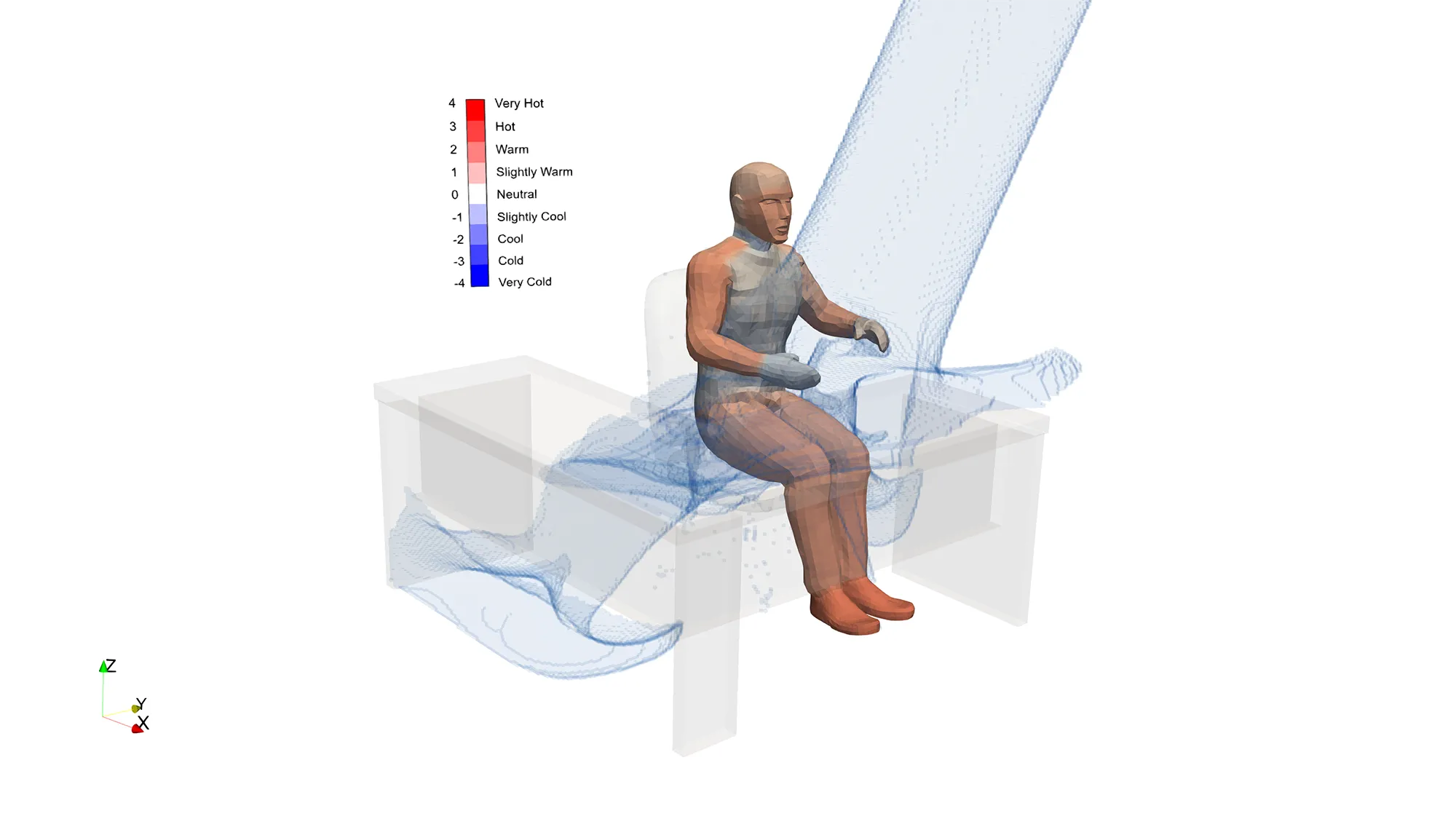
RapidFlow supports dynamic specifications of inlet boundary conditions, such as velocity and temperature, allowing it to interface with external system-level modeling tools. This capability enables the creation of holistic thermal models where a 1D plant model drives the 3D fluid environment. This is essential for developing active controllers that react to sensors represented by 3D domains or human responses in real-time.
External Controller Integration
Couples with 1D tools or user scripts, typically using TAITherm Input and Output parameters, to drive HVAC or other system response based on 3D data.
Functional Mock-up Interface (FMI) Compatibility
Models using RapidFlow can be exported as industry-standard FMUs for import and co-simulation with a variety of system/1D modeling tools.
Closed-Loop HVAC Simulation
Enables thermal comfort-based control of HVAC systems in automotive cabins.

Automated Pre-Processing & Mesh
To reduce the burden on the thermal engineer, RapidFlow features automatic fluid domain pre-processing and meshing based on standard thermal model surface geometry. This logic ensures that 3D airflow analysis can be added to a project without the need for specialized CFD expertise or painstaking grid generation and debugging. The automated workflow drastically reduces model build time, enabling simulation-driven design earlier in the development cycle.
Automatic Multiple Fluid Domain Generation
Quickly defines one or more fluid volumes based on selecting surfaces of existing thermal geometry.
Streamlined User Experience
Designed specifically for thermal engineers without a steep CFD learning curve, using only a few straightforward configuration parameters to define a mesh.
Minimized Setup Time
Drastically reduces the time required to prepare a model for 3D fluid analysis by quickly and automatically generating the fluid mesh.
Flexible Level of Detail
Easily adjust from coarse, rapid results to high-fidelity analysis with minor changes to the same model.
Electronics Thermal Analysis
For high-performance computing, automotive auxiliary electronics, and telecommunications, CoTherm manages the coupling between thermal, fluid, and power-draw models.
Dynamic Workload Analysis
Coordinates realistic duty cycles, such as how a CPU/GPU “burst” of activity creates transient heat that the cooling system must mitigate.
Material Stack-Up Study
CoTherm’s automation of design sweeps pairs with TAITherm’s powerful multilayer modeling and thermal linking capabilities to easily study the thermal impact of different chip layout, cooling device, or TIM (Thermal Interface Material) choices across a design space.
Environmental Influence Considerations
Automated workflows enable comprehensive studies of how external ambient changes affect the internal operating temperature of electronics enclosures.
Engineered for
Real-World Applications
Cabin Climate Control & Occupant Comfort
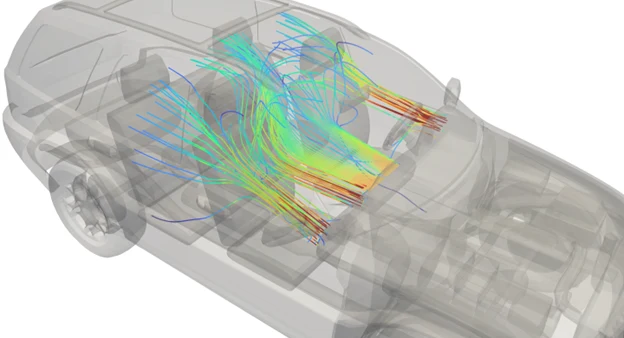
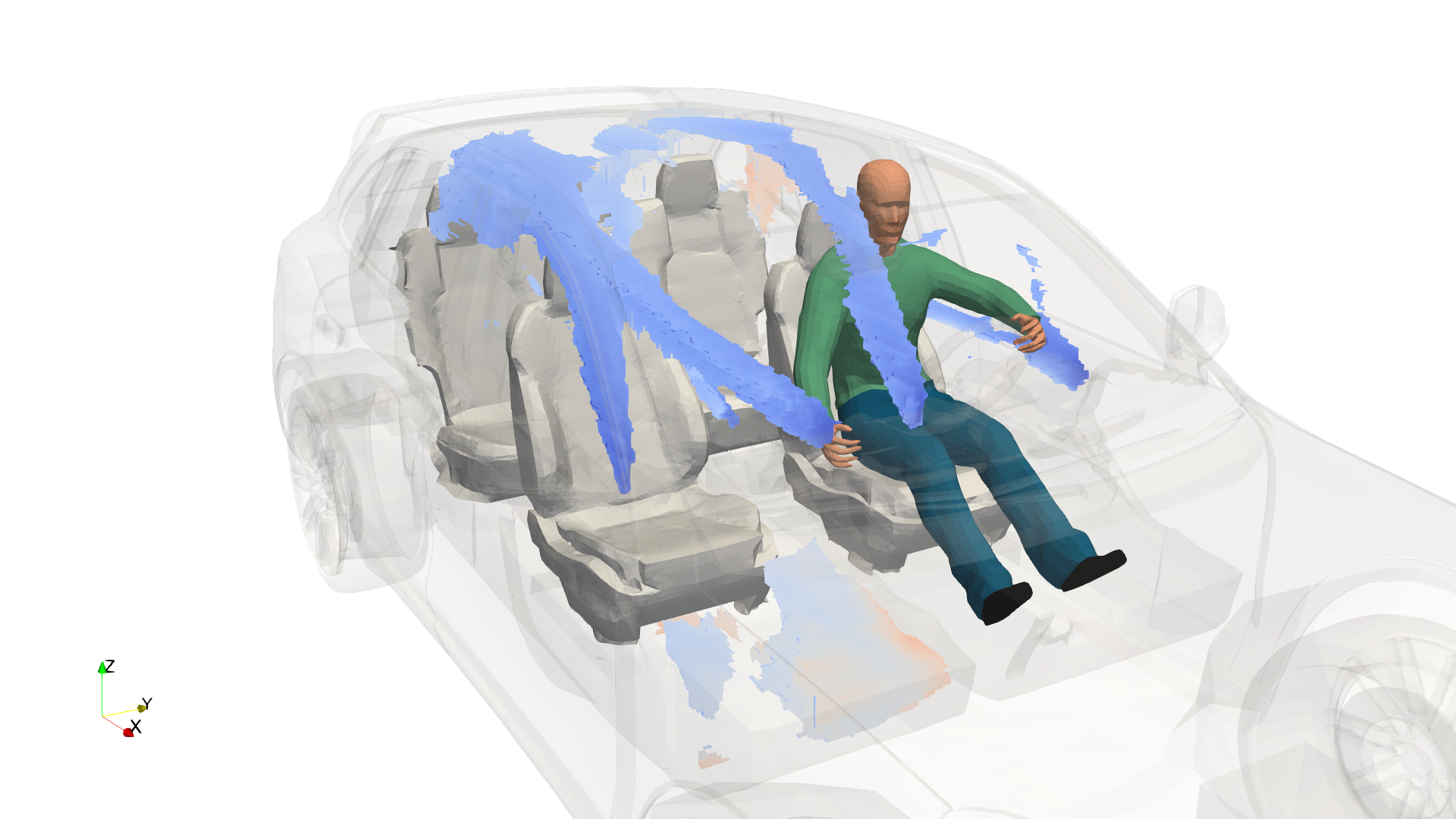
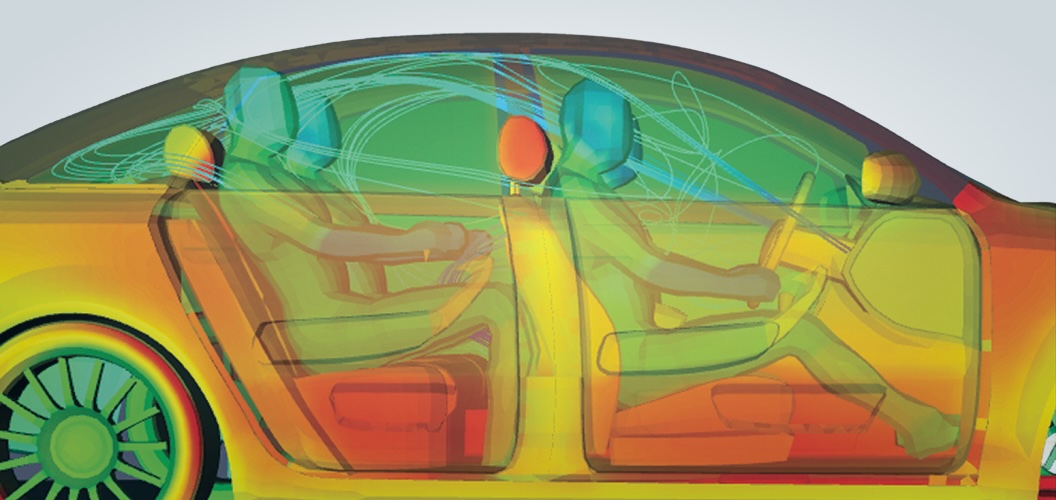
Designing efficient HVAC systems requires understanding localized thermal comfort under transient cool-down or warm-up conditions with pre-conditioning from vehicle-only soak conditions. RapidFlow is effective for adding 3D airflow effects to both modeling scenarios. RapidFlow seamlessly integrates with TAITherm’s Human Thermal Extension to simulate 3D airflow patterns around passengers, calculating precise air temperature and convective coefficients. This allows engineers to optimize vent placement and HVAC power usage while maintaining neutral occupant sensation.
Localized Thermal Comfort
Predicts local human sensation, comfort, and thermoregulation in asymmetric airflows.
HVAC Efficiency Optimization
Fast simulations, comprehensive heat transfer and energy reporting, and system model coupling make it easy to evaluate energy use and system effects during transient cycles.
Soak and Cool-Down Analysis
Simulates the rapid temperature changes and time-to-comfort in a cabin after various pre-conditioning scenarios in real-world or environmental chamber conditions.
Defrost Performance
Analyzes detailed airflow across windows and couples with TAITherm phase change modeling to ensure safety and visibility performance standards are met.

IR Signature Management & Defense
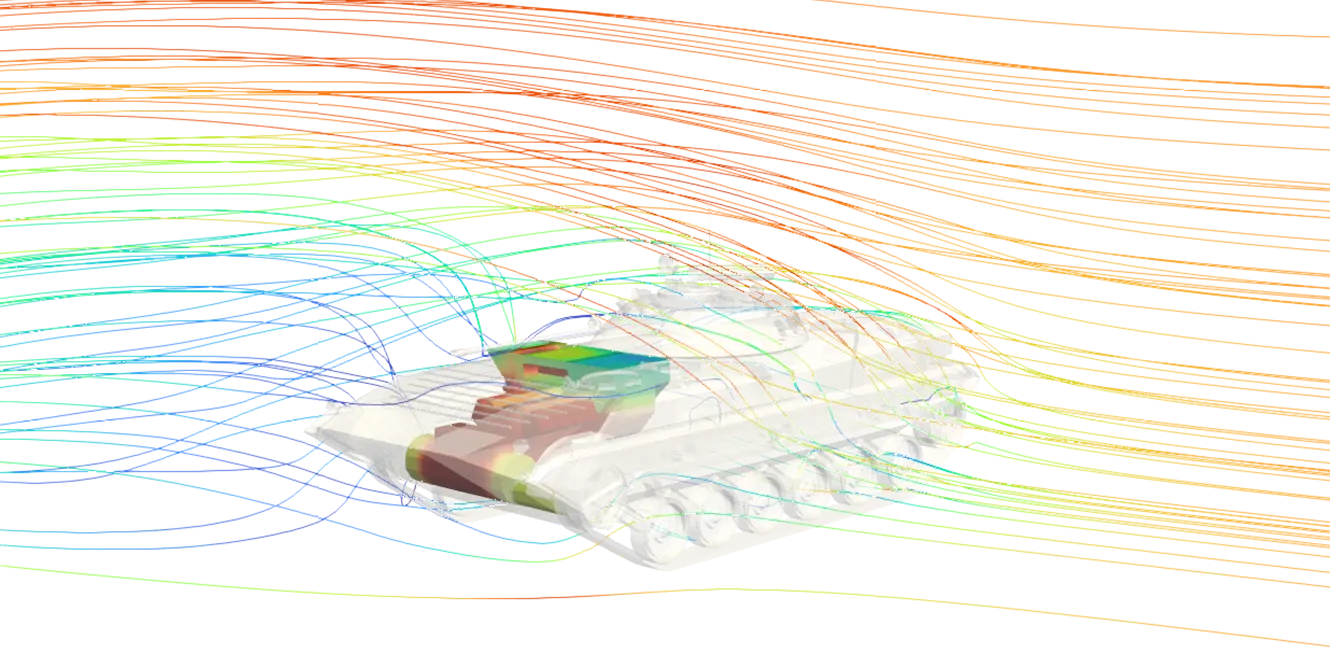
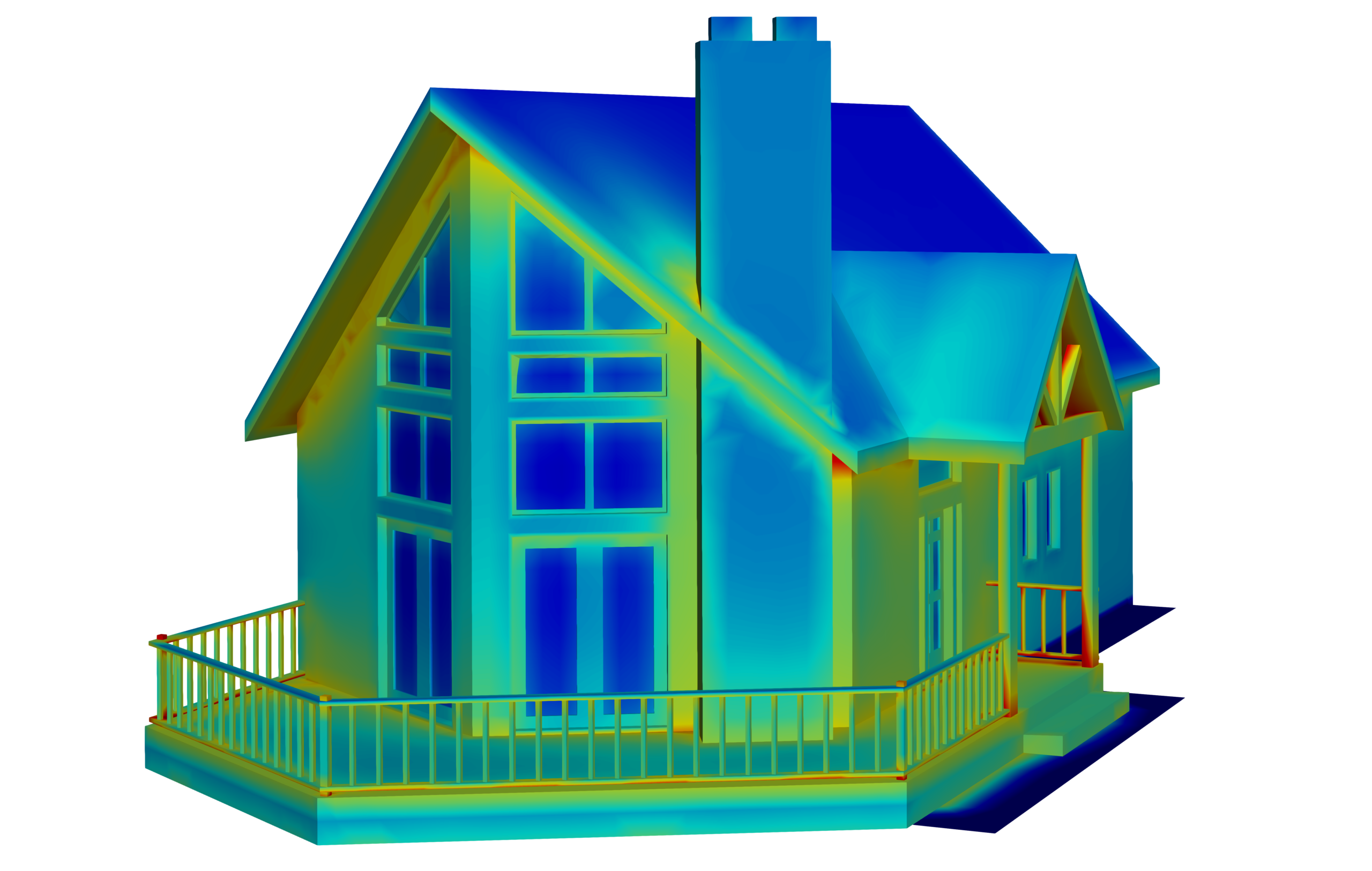
For ground vehicle survivability, capturing the impact of wind and natural convection on surface temperatures is critical for realistic infrared predictions. RapidFlow enhances MuSES simulations by automatically deriving transient wind effects from natural weather data and applying them to the 3D vehicle model. This ensures that defense target surface temperatures are modeled with sufficient accuracy for sensor prediction and signature mitigation.
Transient Wind Modeling
Captures the dynamic effect of changing wind speed and direction on vehicle temperatures and signatures.
Camo Treatment Evaluation
Tests how camouflage effectiveness changes under varying environmental flows with subtle 3D convective influences.
Realistic Weather Integration
Uses air temperature and wind speed specified in standard MuSES weather files for high-fidelity IR renderings using measured or reference weather data.
Probability of Detection (POD) Metric Improvement
Provides more accurate POD predictions through physics-based 3D convection effects.
Electronics & General Thermal Systems
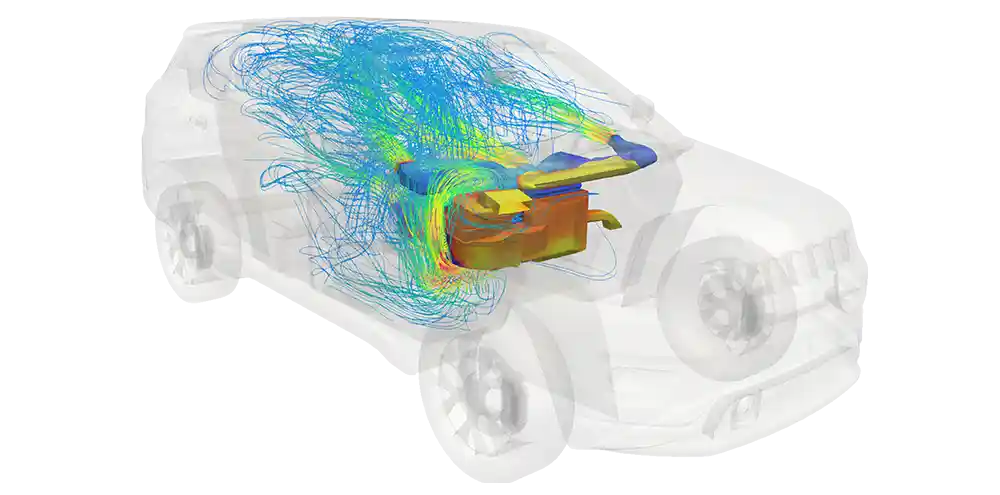
In component-level thermal management, airflow is often a key cooling mechanism but is difficult to model accurately without full CFD. RapidFlow provides a fast 3D solution for analyzing internal or external flow across heat sinks, circuit boards, and battery packs. Multiple independent fluid domains can be coupled to any thermal simulation, allowing for complex system cooling analysis in a fraction of traditional run times.
Heat Sink Optimization
Evaluates effects of heat sink design including fin density and airflow bypass in localized electronics, coupled to TAITherm’s powerful conduction modeling features.
Functional Mock-up Interface (FMI) Compatibility
Models using RapidFlow can be exported as industry-standard FMUs for import and co-simulation with a variety of system/1D modeling tools.
Underhood & Underbody Simulation
Models complex flow paths and hot spots in vehicle engine compartment and underbody domains with fast-running coarse mesh or localized fluid volumes.
Multi-Domain Coupling
Handles multiple fluid regions within a single, complex thermal model.

Automated Pre-Processing & Mesh
To reduce the burden on the thermal engineer, RapidFlow features automatic fluid domain pre-processing and meshing based on standard thermal model surface geometry. This logic ensures that 3D airflow analysis can be added to a project without the need for specialized CFD expertise or painstaking grid generation and debugging. The automated workflow drastically reduces model build time, enabling simulation-driven design earlier in the development cycle.
Automatic Multiple Fluid Domain Generation
Quickly defines one or more fluid volumes based on selecting surfaces of existing thermal geometry.
Streamlined User Experience
Designed specifically for thermal engineers without a steep CFD learning curve, using only a few straightforward configuration parameters to define a mesh.
Minimized Setup Time
Drastically reduces the time required to prepare a model for 3D fluid analysis by quickly and automatically generating the fluid mesh.
Flexible Level of Detail
Easily adjust from coarse, rapid results to high-fidelity analysis with minor changes to the same model.
Rigorously Validated for
Real-World Practicality
RapidFlow provides the specialized depth for heat transfer that general-purpose tools lack by delivering a solution with balanced trade-offs of fidelity vs. runtime. By unifying the thermal and fluid solvers and using efficient solver methods, RapidFlow reduces computational time by up to tenfold compared to standard transient CFD-coupling methods

10x Faster Computation
Achieve comparable 3D accuracy in a fraction of the time required for standard CFD-thermal coupling.

Reduced Time-to-Market
Execute more design iterations and meet aggressive deadlines with streamlined workflows.

Ease of Implementation
Low user burden and automatic meshing allow thermal engineers to run 3D fluid analysis without expert CFD training.

Holistic Thermal-Fluid Accuracy
Comprehensive physics-based simulation to ensure all modes of heat transfer are accurately represented in every scenario and give confidence when validating against physical test data.
ThermoAnalytics Product Hub
Different teams use our tools in different ways.

Simulate real-world thermal behavior across complete systems with validated, multiphysics accuracy.
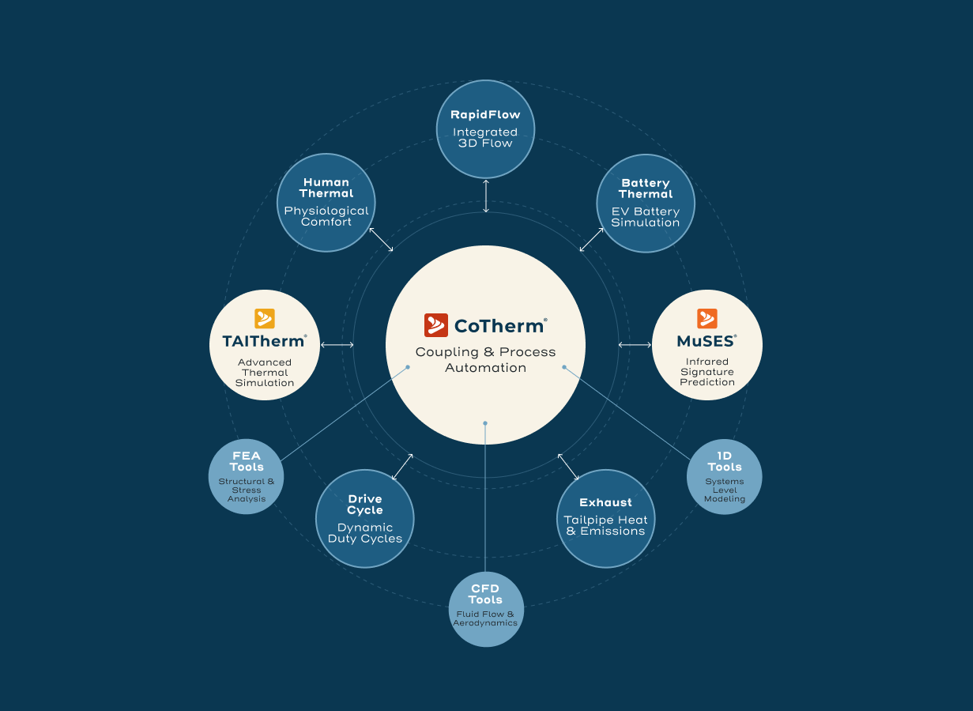

Automate, orchestrate, and streamline multiphysics simulation workflows across tools and teams.

Predict EO/IR signatures in real environments for mission-critical visibility and survivability analysis.