

Multi-Physics Co-Simulation Software for Complex CAE Workflows
Seamlessly automate multi-physics coupling across disparate CAE solvers to accelerate complex, transient engineering analysis.
Power Co-Simulation with Intelligent Automation
CoTherm is an advanced process automation and CAE coupling software designed to streamline the most complex multi-physics simulation workflows. It serves as the intelligent bridge between disparate simulation tools, allowing engineers to synchronize simulations of 3D high-fidelity thermal models, CFD models, 1D system models, and other analyses. By automating data exchange and iteration, CoTherm eliminates the manual errors and time-sinks traditionally associated with co-simulation.
The software is engineered to maximize engineering efficiency through a visual, task-based process workflow. It enables the creation of sophisticated simulation pipelines – including automated meshing, solver execution, and post-processing.. With CoTherm, organizations can achieve automated high-fidelity co-simulation workflows, ensuring that every simulation technique is accounted for across the entire design cycle.

Maximize Engineering Throughput
CoTherm eliminates the “manual bottleneck” by automating the repetitive data-handling tasks that consume an engineer’s day.

Eliminate Costly Manual Errors
CoTherm’s synchronized coupling ensures that boundary conditions are mapped with mathematical precision every time, reducing the risk of making critical design decisions based on flawed data.

Shorten Design Exploration Cycles
With built-in Optimization and Design of Experiments (DOE), CoTherm allows you to explore hundreds of design variations automatically.

Future-Proof with Digital Twins
CoTherm enables the creation of high-accuracy Reduced Order Models (ROMs) that run in real-time.
Advanced Capabilities for
Complex Multiphysics Simulations
Seamless Multiphysics Coupling
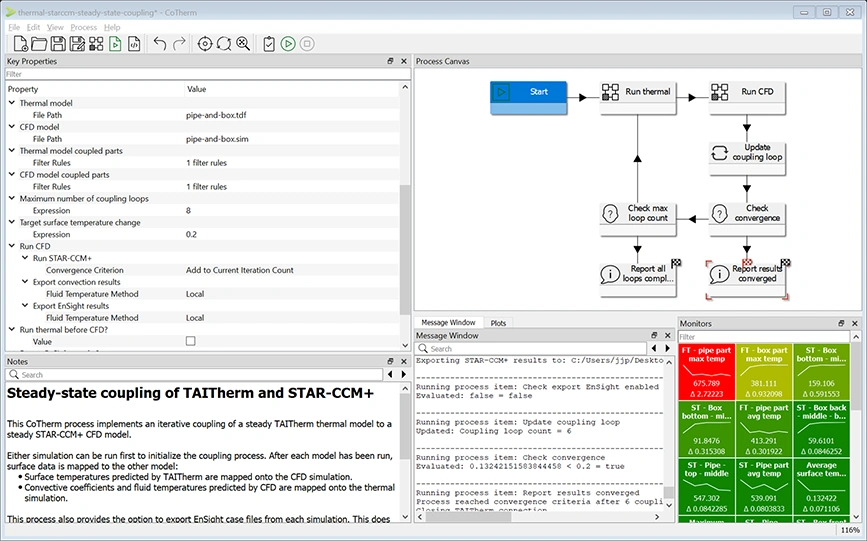
CoTherm acts as the central facilitator for multiphysics simulations, bridging the gap between specialized solvers that typically “speak different languages.” By establishing a synchronized data exchange, it allows engineers to account for the co-dependent effects between fluid dynamics, heat transfer, and 1D system models. This eliminates the need for manual data import and ensures that every solver in the chain is working with the most accurate boundary conditions.
3D-to-1D Coupling
Connects high-fidelity 3D CFD or thermal models with 1D system tools for comprehensive accuracy.
Automatic 3D-to-3D Mapping
Employs advanced spatial and temporal mapping to ensure data consistency between different model domains.
Bi-Directional Data Exchange
Supports simultaneous, two-way communication between solvers for tightly coupled transient physics.
Extensive Tool Library
Features built-in connectors for industry-standard CAE tools.
Process Automation & Workflow Management
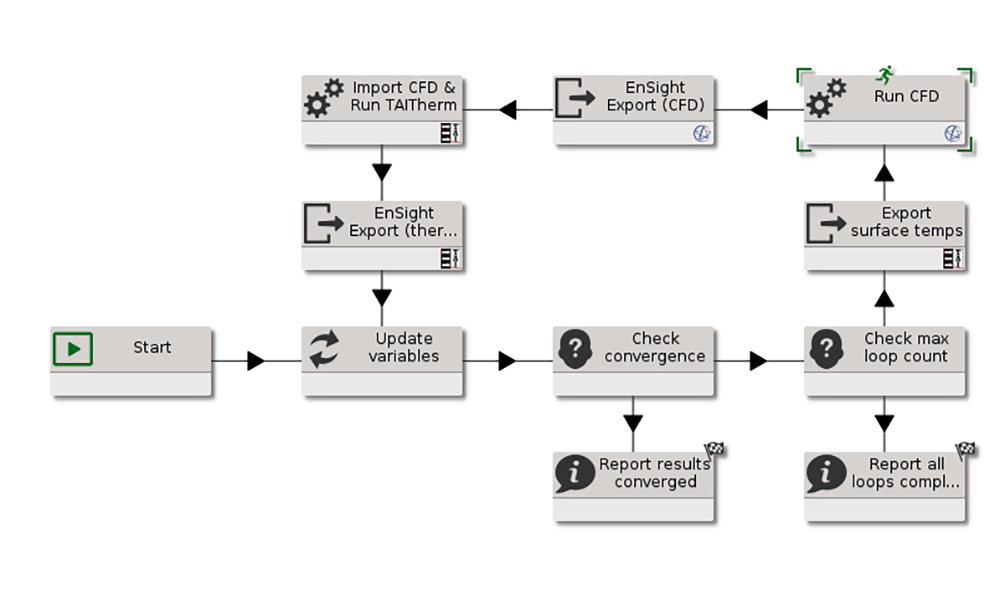
Manual simulation workflows are prone to data entry errors. CoTherm’s automation engine allows users to wrap complex sequences, from geometry prep and meshing to solving and post-processing, into a single, repeatable process. This capability ensures that best practices are standardized across an organization and that simulation assets can be re-run with new parameters or CAD geometry seamlessly.
Visual Process Workflow
Uses an intuitive graphical interface to define logic, loops, and conditional branches in the simulation process.
Automated Iteration Control
Monitors convergence of key outputs of interest and whole-model statistics across multiple solvers to automatically determine when to move to the next simulation step.
Error Handling & Recovery
Detects solver crashes, licensing issues, or other errors and can apply predefined workflows to automatically restart or pause the workflow to prevent data loss and wasted time.
Headless Execution
Enables workflows to be deployed on remote clusters or high-performance computing (HPC) nodes without GUI overhead. Complete process deployment can be integrated with job schedulers and web-based submission & tracking tools.
Design of Experiments (DOE) & Optimization
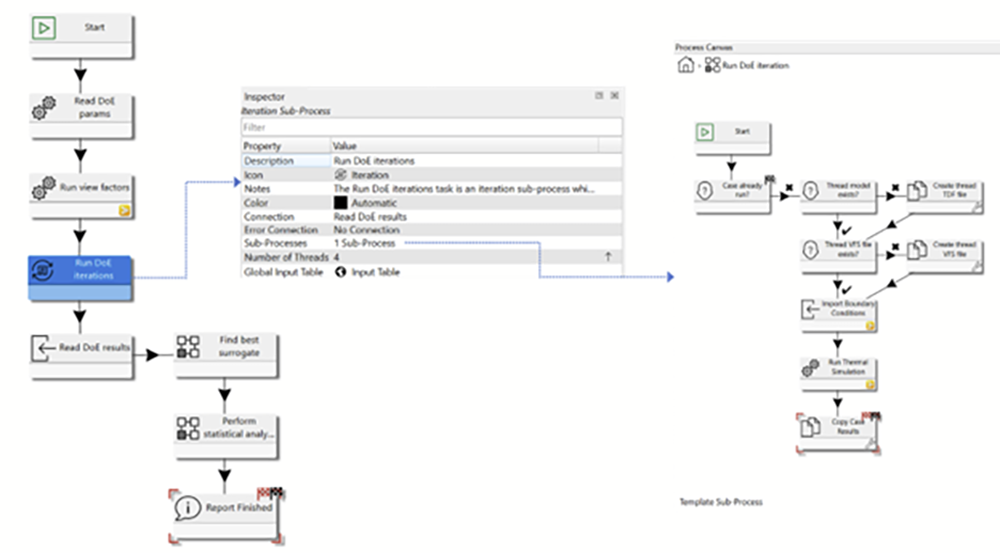
Engineering is rarely about a single simulation; it’s about finding the best design within a set of constraints. CoTherm automates the “what-if” process by driving solvers through hundreds of iterations to identify sensitivities and optimal configurations. This capability moves the engineer from being a “tool operator” to a “data analyst,” as the software handles the tedious task of launching, monitoring, and harvesting data from design sweeps.
Parametric Sweeps
Automatically varies input parameters, such as geometry dimensions or flow rates, to study system sensitivity.
Optimization Algorithms
Uses built-in optimizer with multiple local or global methods or integrates with external solvers to find the best design based on user-defined constraints and objectives.
Response Surface Modeling
Generates a statistical “map” of the design space based on simulation results to predict performance between data points.
Distributed Task Management
Parallelizes DOE runs across available hardware resources to dramatically reduce total clock time.
Reduced Order Model (ROM) Creation
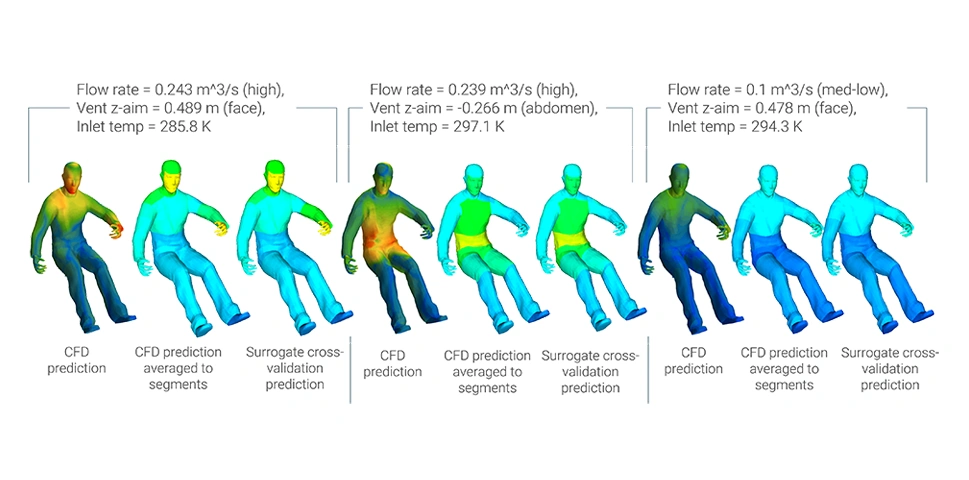
CoTherm facilitates the creation of Reduced Order Models (ROMs), mathematical simplifications that retain the accuracy of the original simulations but run in a fraction of the time. CoTherm manages the massive “training” data sets required to build these models, allowing high-fidelity physics to be utilized in 1D system simulations, rapid optimization, or vehicle controller development.
Training Data Automation
Coordinates the massive number of 3D runs required to “train” a high-accuracy ROM based on user-defined model inputs and ranges.
Trained Model Export
Creates models that can be exported for use in external simulation environments or control system development.
Model Validation Tools
Validates ROM predictions against full 3D simulation behavior to ensure the simplified model maintains accuracy.
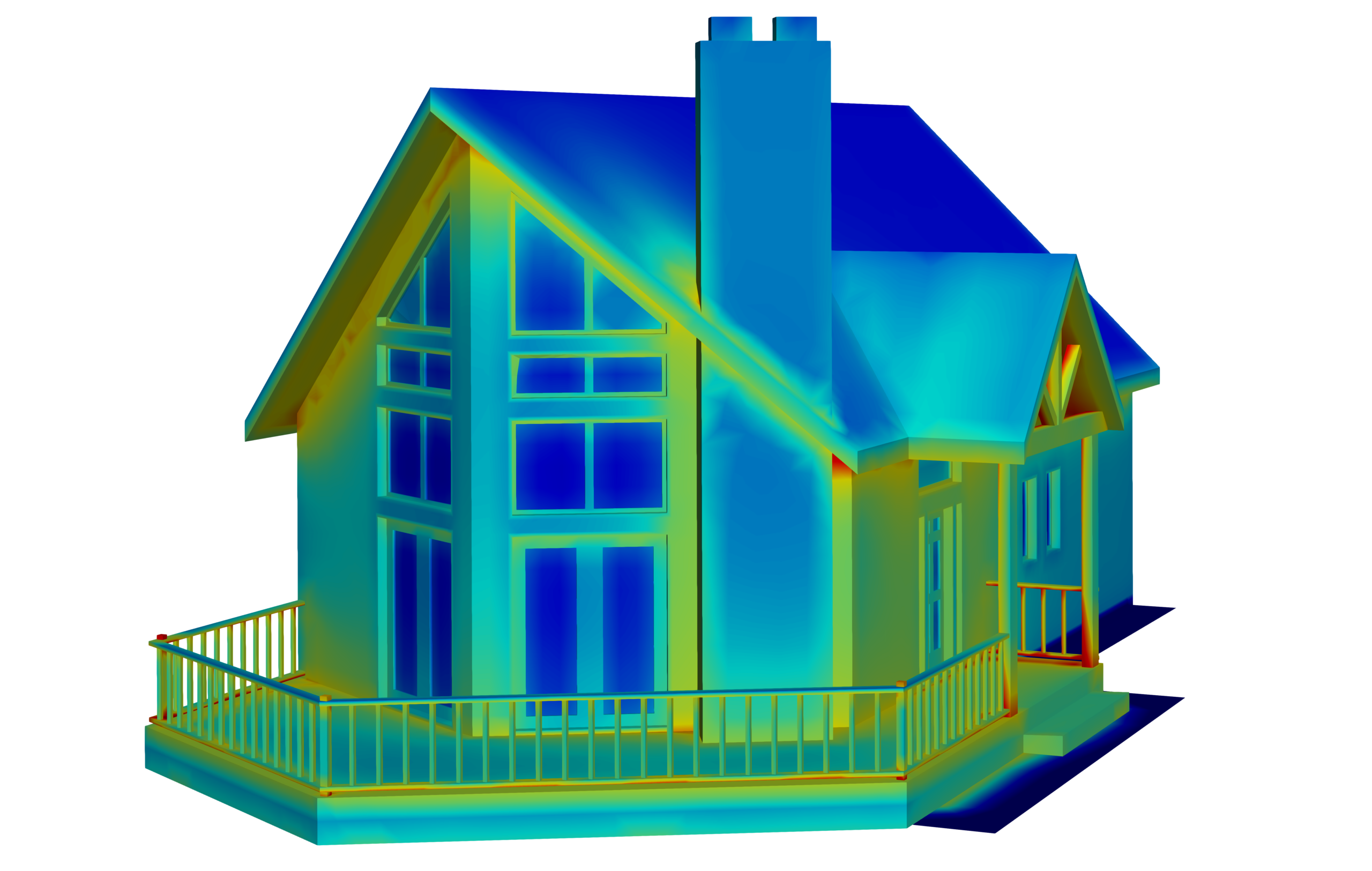
Electronics Thermal Analysis
For high-performance computing, automotive auxiliary electronics, and telecommunications, CoTherm manages the coupling between thermal, fluid, and power-draw models.
Dynamic Workload Analysis
Coordinates realistic duty cycles, such as how a CPU/GPU “burst” of activity creates transient heat that the cooling system must mitigate.
Material Stack-Up Study
CoTherm’s automation of design sweeps pairs with TAITherm’s powerful multilayer modeling and thermal linking capabilities to easily study the thermal impact of different chip layout, cooling device, or TIM (Thermal Interface Material) choices across a design space.
Environmental Influence Considerations
Automated workflows enable comprehensive studies of how external ambient changes affect the internal operating temperature of electronics enclosures.
Engineered for
Real-World Applications
Integrated Vehicle Thermal Management
CoTherm’s powerful coupling and automation capabilities enable comprehensive simulations for vehicle thermal management and heat protection, ensuring that complex geometry and heat transfer details are properly represented to verify heat shielding design and protection of sensitive components.
Multi-Scenario Modeling
Standard coupling workflows available for steady-state, transient hot soak, and transient dynamic driving vehicle scenarios.
Automated Monitoring and Reporting
Key results are tracked and visualized during coupled simulations. CoTherm’s monitoring features can be combined with TAITherm’s thermal reporting and design temperature limit tracking for fully automated analysis of heat damage risks.
Predictive Simulations and Model Customization
Beyond coupling solvers, CoTherm workflows can also modify model parameters and apply custom scripts to control model configuration for heat sources, heat exchanger and fan models, and driving conditions across 3D and 1D models to allow fully predictive simulations with minimal risk of errors in inputs.
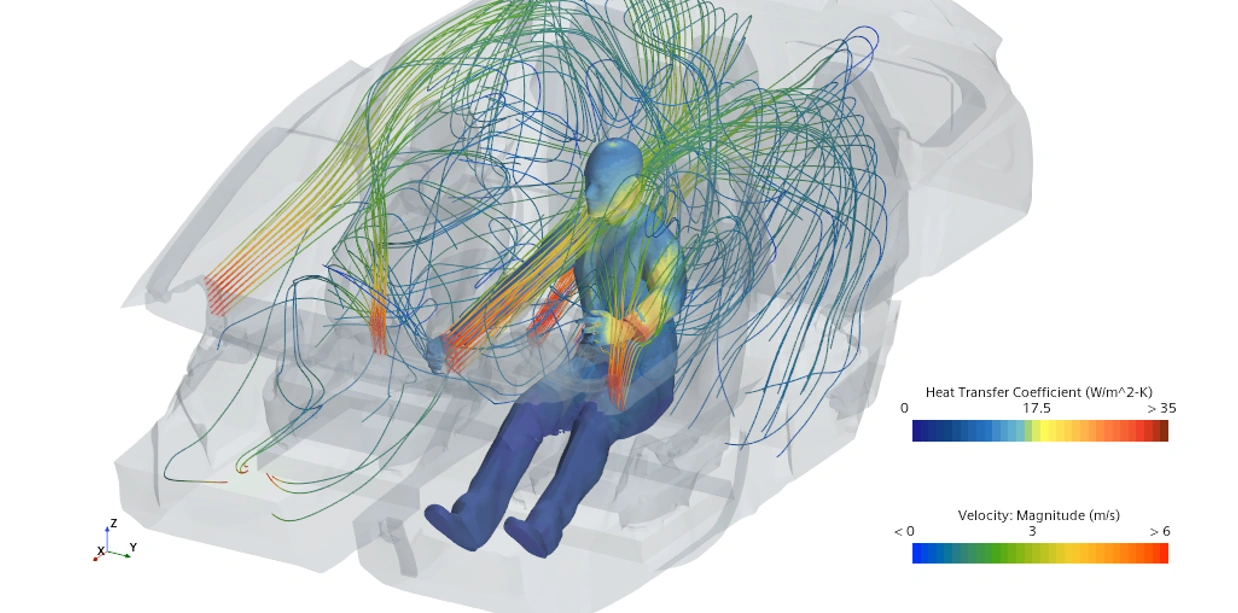
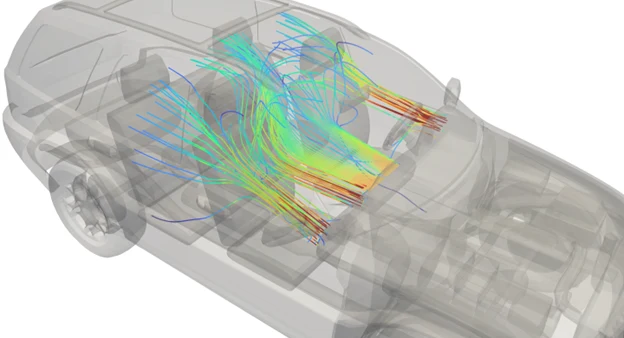
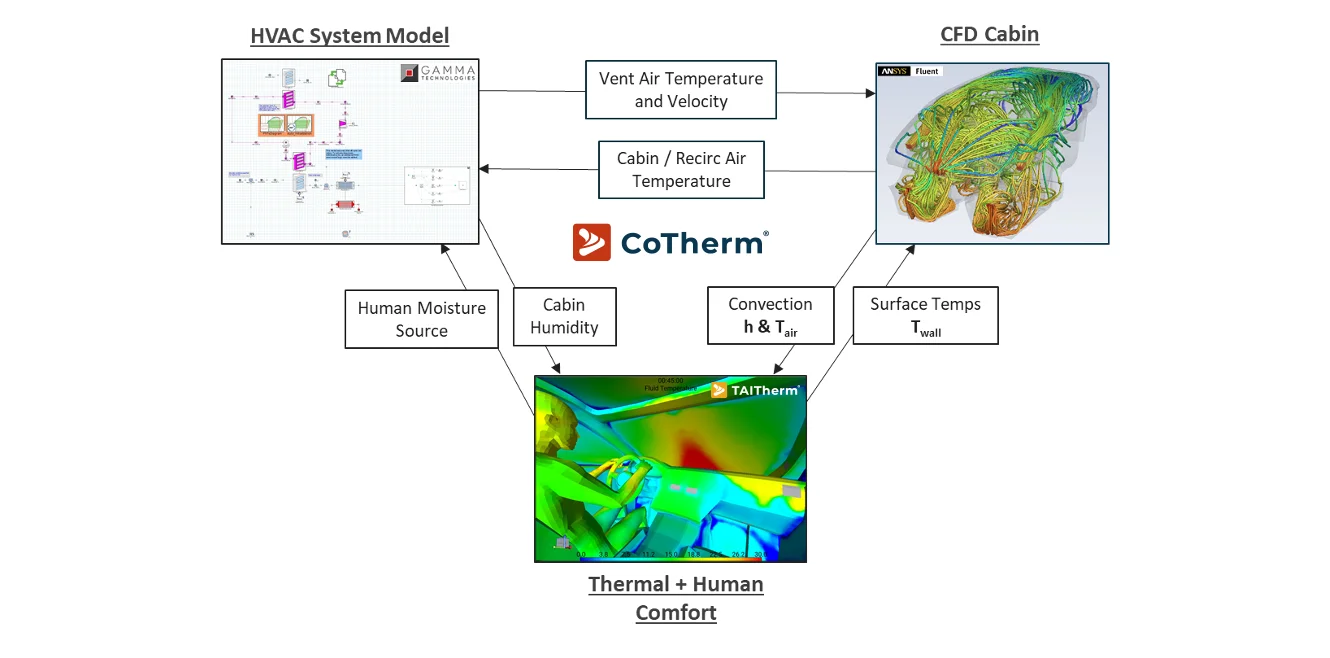
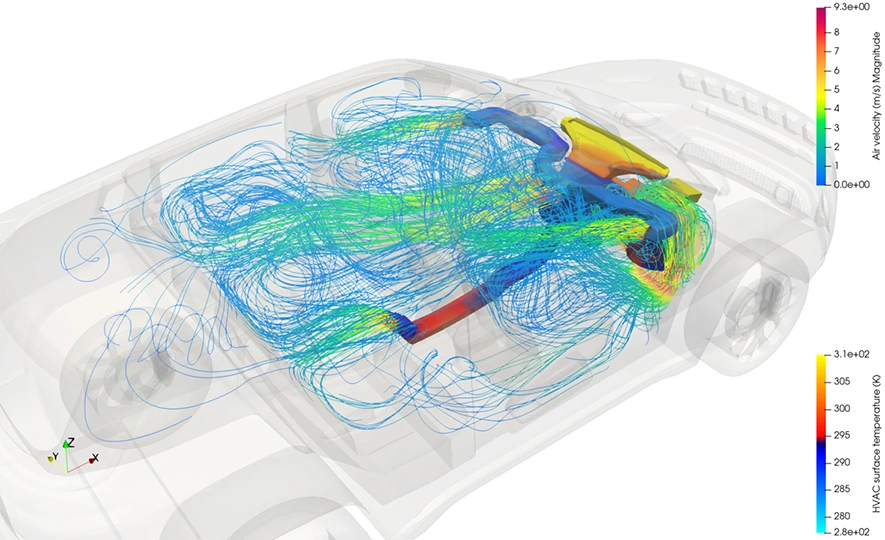
Cabin HVAC System Design and Thermal Comfort
CoTherm’s automation and coupling features that work across the spectrum of scientific discipline and model fidelity allow a variety of effective workflows for cabin analysis pertaining to HVAC system effects and human thermal comfort.
Automated Pre-Conditioning and Transient Simulation
CoTherm’s flexible coupled analysis workflows can be combined to automate any desired combination of human pre-conditioning, vehicle pre-conditioning, and warm-up or cool-down scenarios under a variety of environmental conditions.
Streamlined Reporting and Analysis
Models of cabins with humans produce a massive amount of 3D heat transfer, fluid dynamics, and human physiology/comfort results. CoTherm allows this information to be automatically extracted, organized, plotted, and analyzed with flexible connections to post-processing capabilities in all linked modeling tools.
HVAC Control Algorithm Design and Optimization
By providing a high-fidelity plant model for control algorithms, CoTherm allows engineers to calibrate software long before a physical prototype exists. CoTherm’s software integrations allow you to directly link your MATLAB/Simulink or Python control code with a high-fidelity thermal simulation or ROM. Human physiology and comfort metrics can be linked with control algorithms to design and validate comfort-based control strategies.
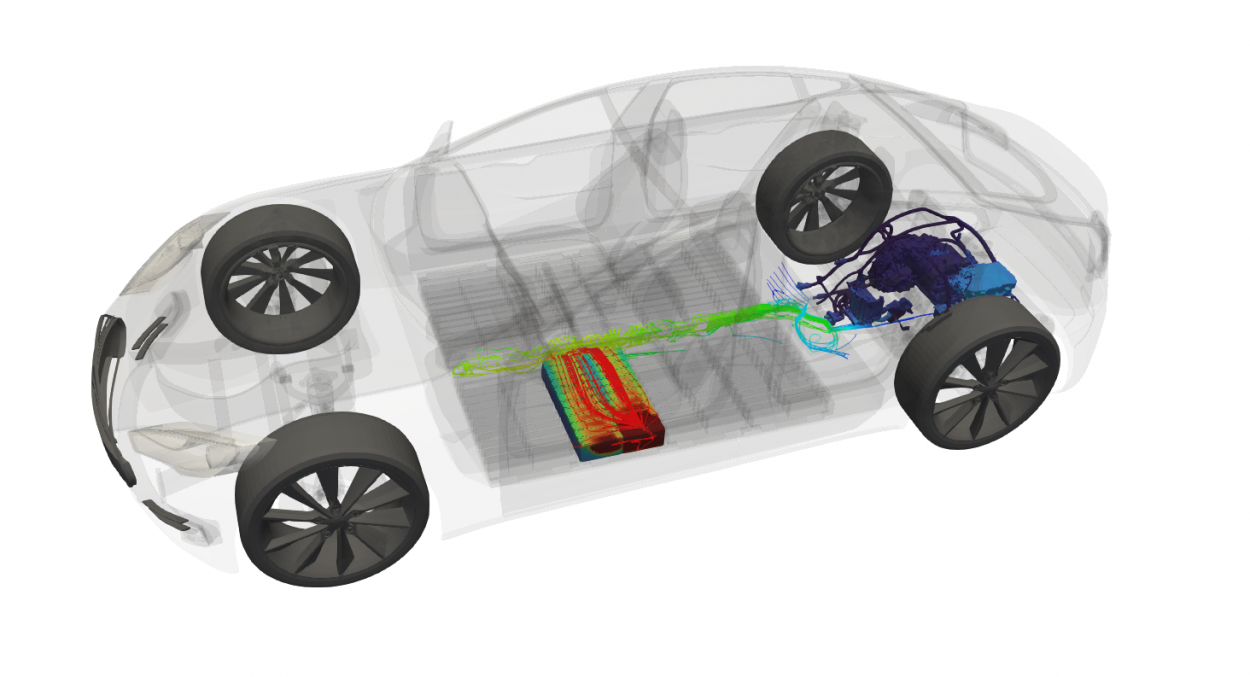
Battery Pack Thermal Safety
CoTherm automates the complex coupling required to simulate battery modules, where electrical loads, battery chemistry, and cooling systems all interact.
Cooling System Performance
Supports various combinations of 3D thermal, 3D fluid, and 1D models to analyze how battery cooling strategies impact temperature uniformity across thousands of cells.
Abuse Scenario Simulation
Automates co-simulation of thermal runaway propagation and venting effectiveness utilizing multiphysics simulations.
Battery Lifetime Modeling
Standard workflows combine “day-in-the-life” 3D simulations repeated over different environmental conditions throughout the lifetime of a battery pack with coupled lifetime calculations that predict changes in battery capacity due to aging.
Electronics Thermal Analysis
For high-performance computing, automotive auxiliary electronics, and telecommunications, CoTherm manages the coupling between thermal, fluid, and power-draw models.
Dynamic Workload Analysis
Coordinates realistic duty cycles, such as how a CPU/GPU “burst” of activity creates transient heat that the cooling system must mitigate.
Material Stack-Up Study
CoTherm’s automation of design sweeps pairs with TAITherm’s powerful multilayer modeling and thermal linking capabilities to easily study the thermal impact of different chip layout, cooling device, or TIM (Thermal Interface Material) choices across a design space
Environmental Influence Considerations
Automated workflows enable comprehensive studies of how external ambient changes affect the internal operating temperature of electronics enclosures.
Rigorously Validated for
Real-World Accuracy
By integrating 1D systems and 3D high-fidelity physics into a unified, automated pipeline, CoTherm empowers teams to shift their focus from managing solvers to analyzing results and discovering optimal designs through automated exploration. CoTherm is designed to empower CAE analysts with extensive workflow examples, integrations customized to each vendor’s paradigm, and HPC integration features designed for modern CAE environments.

Eliminate Workflow Complexity
Replace manual data transfers with automated, repeatable processes that link 1D and 3D solvers into a single, cohesive simulation pipeline.

User-driven Software Development
CoTherm features are continuously improved based on real-world user feedback from running high-resolution coupled simulations within rapid design cycles. New versions are released twice a year and example workflows and tutorials are regularly updated with latest best practices.

Smart Multi-Physics Coupling
Bridge the gap between thermal, CFD, and system-level tools to achieve a “total system” view that comprehensively predicts design performance.

Accelerated Design Discovery
Use built-in DOE and optimization tools to automatically explore hundreds of design iterations, finding the “sweet spot” for performance and cost.

Future-Proof with ROMs
Generate high-accuracy Reduced Order Models (ROMs) that bring 3D physics into real-time control systems and digital twin applications.
Enhance CoTherm with
Powerful Extensions
ThermoAnalytics product extensions are designed to integrate seamlessly with core solvers to provide high-fidelity, specialized analysis without leaving the primary simulation environment.
RapidFlow
Fast, lightweight airflow and convection modeling for quick early-stage thermal decisions.
Human Thermal
Physiology-based human comfort prediction for realistic cabin, room, and wearable evaluations.
Battery Thermal
Advanced battery and power electronics thermal modeling for EV and hybrid system development.
Exhaust
Simulate exhaust heat flow, aftertreatment behavior, and thermal impact on surrounding systems.
Drive Cycle
Evaluate thermal performance across real-world and standardized drive cycles with transient accuracy.