
Thermal Management & Heat Transfer
Designing Climate-Controlled Seats: Simulation & Comfort Modeling
Optimize Reliability Across Extreme Environmental Conditions
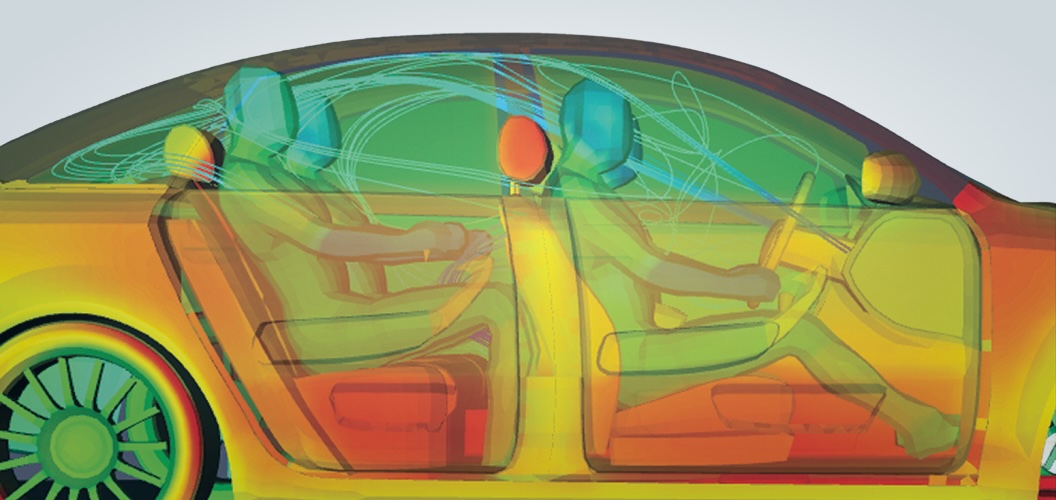
Predicting how a system interacts with the natural world requires more than just calculating heat – it requires simulating the transient conditions that occur. TAITherm provides engineers with the high-fidelity simulation tools necessary to model solar loading, transient weather patterns, and complex surface-to-sky radiation.
From defense vehicles idling in desert heat to high-rise glass structures in urban microclimates, our software ensures that your designs are optimized for reliability, efficiency, and human comfort long before a physical prototype ever faces the elements.

How It Works:
Multi-Physics Transient Analysis
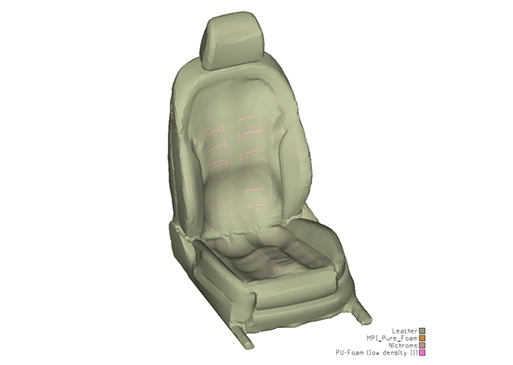
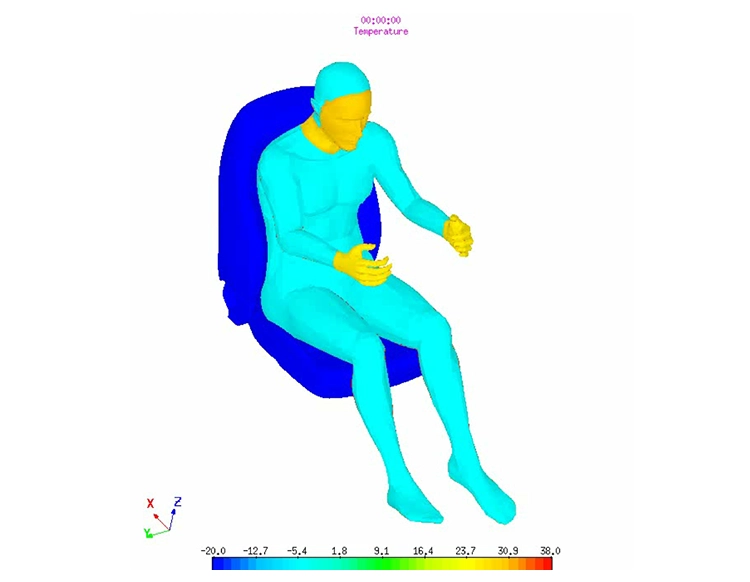
The performance of heating and cooling seating systems is a complex interplay of conduction, convection, and human physiology. When a heated seat is activated, heat is transferred via conduction from heating mats through various layers of foam and trim covers to the occupant. Conversely, ventilated or cooled seats rely on forced convection, where fans circulate ambient or conditioned air through perforated materials to remove latent heat and moisture (sweat) from the occupant’s skin.
ThermoAnalytics’ solver, TAITherm, paired with the Human Thermal Extension, utilizes a specialized human thermal model (the Berkeley Comfort Model) to simulate these interactions. It accounts for:
- Layered Material Properties: Modeling the thermal resistance and capacitance of leathers, fabrics, and foams.
- Active Cooling/Heating Elements: Simulating thermoelectric devices (TEDs) or resistive heating wire meshes.
- Contact Resistance: Accurately calculating the heat flux at the interface between the occupant and the seat surface.
Engineering Without Compromise
By integrating ThermoAnalytics into your design workflow, you transform thermal management from a reactive fix into a competitive advantage.
Transient Warm-up and Cool-down Analysis
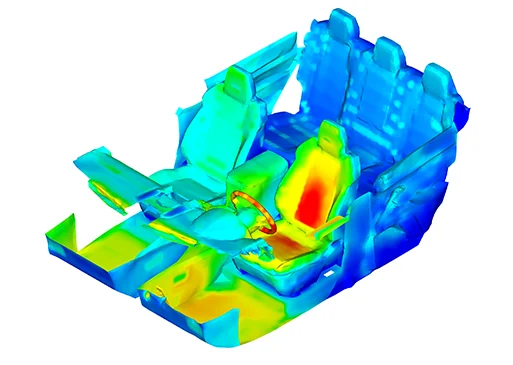
Time to comfort is the primary metric for Heated and Cooled Seating systems. Using transient analysis, engineers can predict the time required for a seat surface to reach a target temperature under extreme soak conditions (e.g., a car parked in -20°C or 50°C). This allows for the optimization of heater wattage and airflow rates without over-engineering the electrical system.
Human Sensation & Comfort Modeling
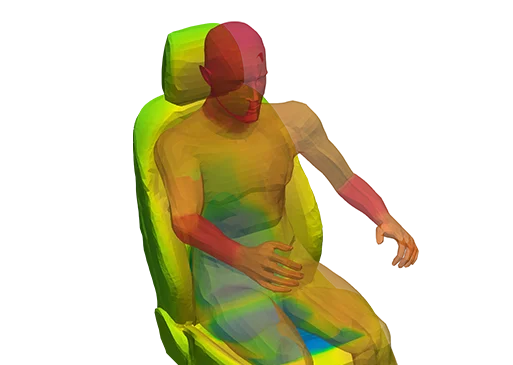
Temperature is only half the story. Our analysis integrates the Berkeley Comfort Model, which predicts local and global comfort. This helps determine if a seat “feels” too hot in specific spots (thighs vs. lower back) or if the cooling effect is sufficient to prevent perspiration, ensuring a premium user experience regardless of the cabin’s ambient state.
Material Selection and Stack-Up Evaluation
The thermal “lag” of a seat is heavily dependent on the material stack-up. We provide the tools to perform “what-if” scenarios on different foam densities, adhesive layers, and trim materials. This ensures that the aesthetic choices made by design teams do not compromise the functional thermal requirements of the engineering team.