
Thermal Management & Heat Transfer
Joule Heating Simulation
Advanced Multiphysics Modeling for xEV, Power Electronics, and Resistive Heating Systems
Joule heating, also known as Ohmic or resistive heating, is the process by which the passage of an electric current through a conductor releases heat. In the context of modern engineering, particularly within the electrification and automotive sectors, managing this thermal energy is critical for component longevity, safety, and performance.
ThermoAnalytics provides a sophisticated multiphysics solution within TAITherm to model localized heating in complex geometries. Our Joule heating module enables engineers to simulate how current and voltage sources interact with conductive materials, accounting for temperature-dependent resistance and intricate part shapes. By integrating these electrical effects directly into the thermal solver, we provide a streamlined workflow for analyzing everything from battery bus bars to de-icing systems.


How It Works
The Joule heating model in TAITherm is a three-dimensional Multiphysics solution with temperature-dependent heat rates, which can be used with parts with varying thickness and arbitrary geometry. Unlike simplified models that rely on equivalent cross-sectional areas, TAITherm uses the intrinsic property of electrical conductivity (the inverse of resistivity) applied to the actual 3D geometry.
The solver generates a matrix of electrical nodes, analogous to thermal nodes, where voltage is the primary variable. Heat generation is calculated as the square of the voltage difference between nodes multiplied by the material’s temperature-dependent conductivity. This allows the software to accurately capture heat rates in parts with varying thicknesses and arbitrary shapes. The model supports both shell and solid elements and can incorporate contact resistance between connected parts, ensuring that localized “hot spots” at interfaces are accurately predicted.
Engineering Without Compromise
By integrating ThermoAnalytics into your design workflow, you transform thermal management from a reactive fix into a competitive advantage.
Electric Vehicle (xEV) Components
Joule heating is a primary thermal consideration in xEV design. Our software is used to model battery cell tabs, bus bars, wiring harnesses, and fast-charger connections. By simulating the resistive losses in these high-current components, engineers can optimize cooling strategies and material selection to prevent thermal runaway and ensure efficient power delivery.

Power Electronics
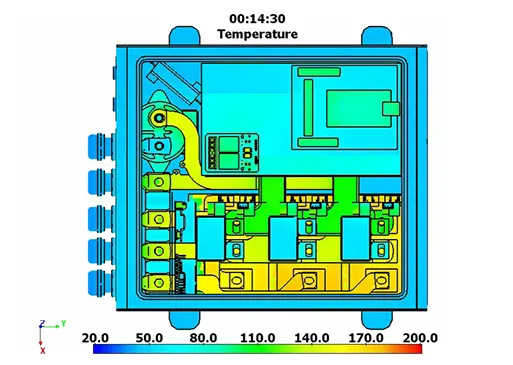
Inverters and electronic circuits experience significant heat loads due to high switching frequencies and current densities. TAITherm allows for the detailed analysis of rotor windings in electric motors and power electronics, helping designers manage thermal gradients that could otherwise lead to component failure or reduced semiconductor lifespan.
Safety & Defrosting Systems
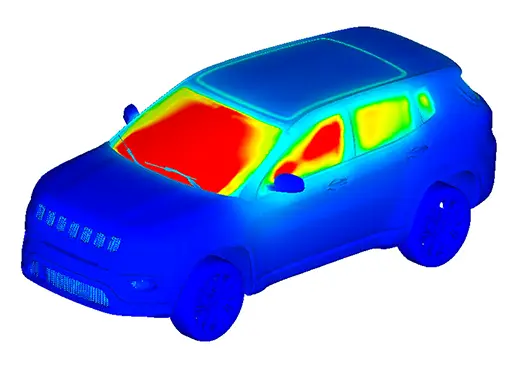
The module is frequently used to simulate resistive elements in windshields and side mirrors for de-fogging and de-icing applications. Engineers can analyze the transient warm-up behavior of these systems to ensure they meet regulatory safety standards for visibility in extreme cold-weather conditions.