
EO/IR Sensor Simulation
UAV Thermal Management and Infrared Signature Simulation
Advanced Multiphysics Solutions for UAS Battery Safety, Avionics Cooling, and Stealth Optimization
As the complexity of Unmanned Aerial Vehicles (UAVs) grows, managing the heat generated by high-performance propulsion systems, onboard electronics, and high-density battery packs has become a critical design challenge. ThermoAnalytics’ MuSES provides industry-leading thermal simulation solutions specifically engineered to optimize UAV performance and detectability. Our software enables engineers to predict transient temperatures and infrared (IR) signatures across diverse operating environments, ensuring flight safety, extending mission duration, and reducing the time-to-market for next-generation UAV platforms.
How It Works:
Multiphysics Transient Analysis
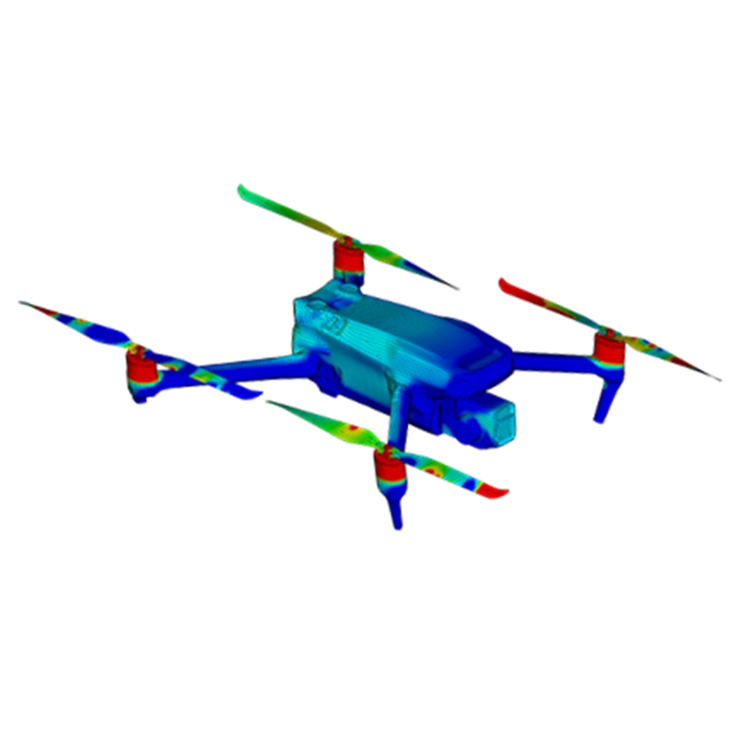
The core of the ThermoAnalytics approach lies in a complete transient multiphysics solver that integrates three-dimensional heat transfer with environmental boundary conditions. Unlike traditional tools that focus on steady-state snapshots, our technology utilizes a fast-transient solver to track the thermal evolution of a UAV throughout its entire mission—from the initial power-up and high-drain takeoff to cruise-phase convective cooling and the post-landing “hot soak” period. By leveraging a highly efficient radiation engine, the software calculates the exchange of energy between internal components and the surrounding environment, accounting for solar loading, atmospheric conditions, and terrain-based thermal reflections.
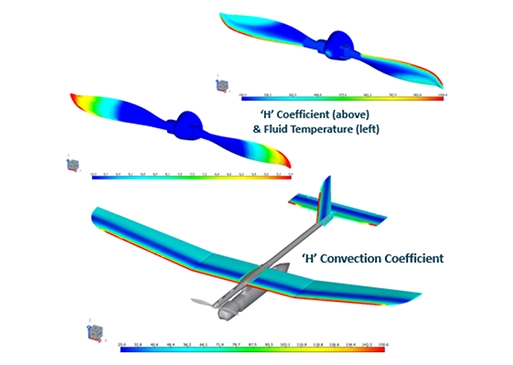
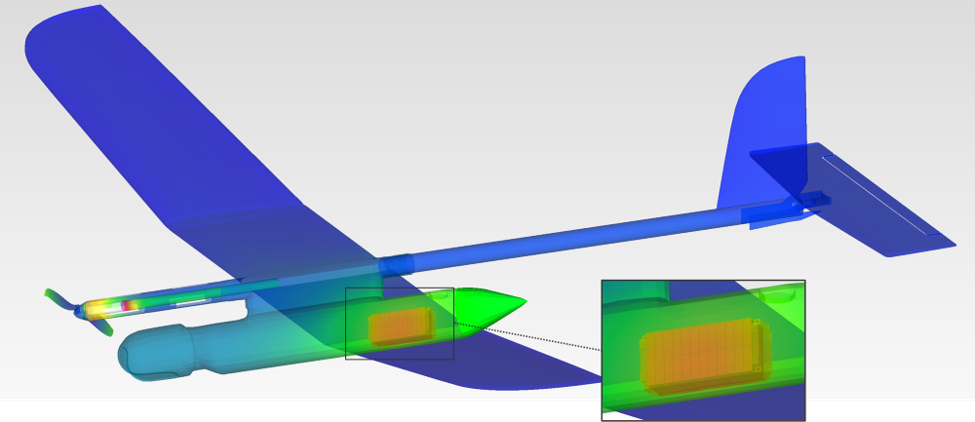
MuSES utilizes an aerodynamic convection library tool to simulate the heat generated from airflow friction on airfoils and nose cones. Wind effects are applied to external surfaces and inlet vents based on the UAV’s speed and ambient weather conditions. Air flow is then propagated around key components and internal cavities, allowing for analysis of convective cooling effects throughout the UAV. This allows engineers to predict not only how hot a component will get, but how its thermal state will fluctuate under different aerodynamic loads and varying boundary conditions, ensuring reliable performance in any theater of operation.
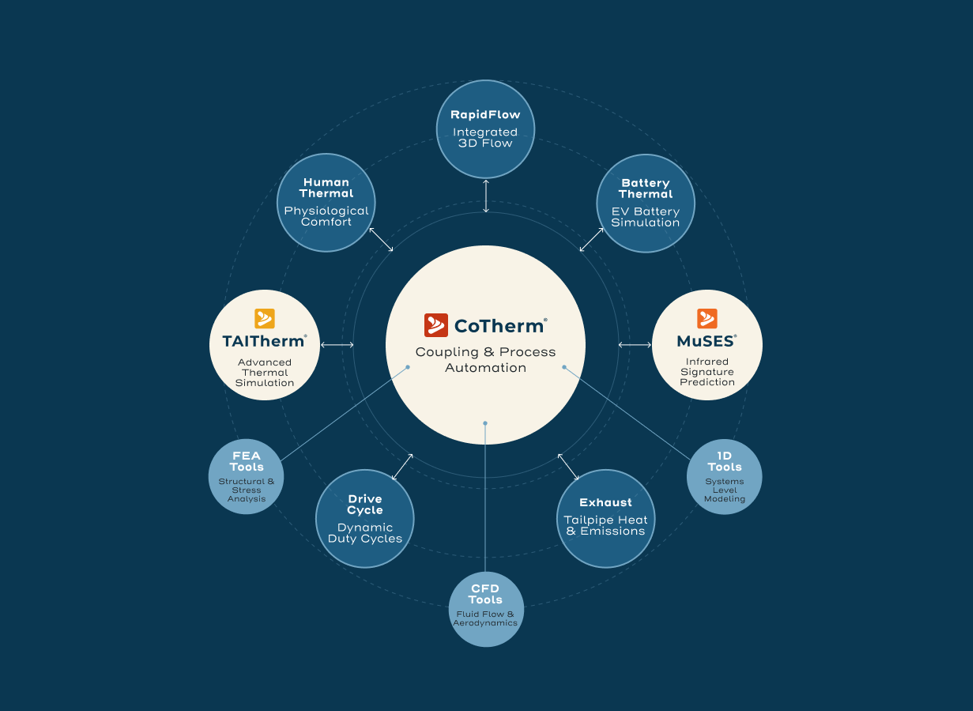
When paired with CoTherm, engineers have the capabilities to alter key inputs such as boundary conditions, speed curves, environmental parameters to perform parametric studies or Design of Experiments (DoE) analyses. This provides critical insight to fully understand the thermal limits of the UAV design in different operating conditions.
Engineering Without Compromise
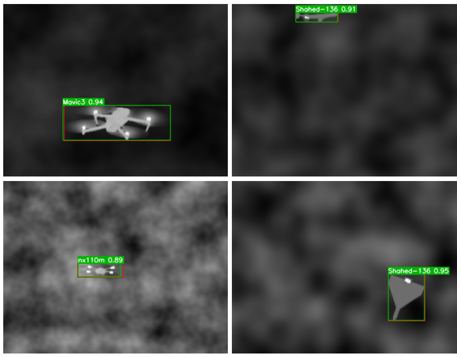
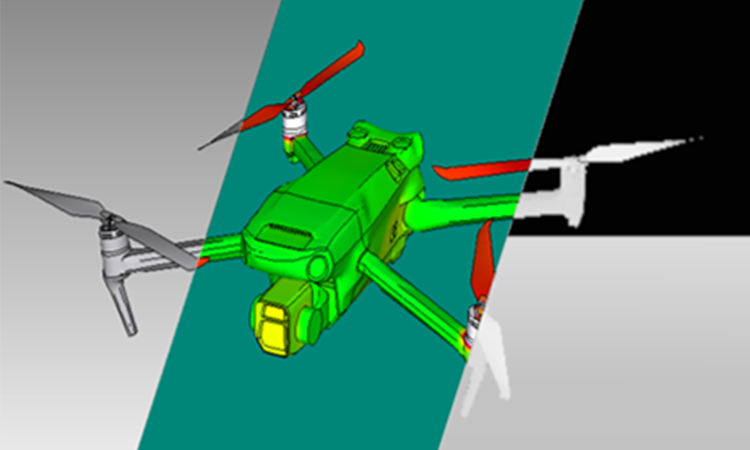
By integrating ThermoAnalytics into your design workflow, you transform thermal management from a reactive fix into a competitive advantage. Engineers can proactively validate component safety margins and overall system reliability under worst-case environmental and mission conditions. High-fidelity IR signature renderings can then be created to provide actionable insights into detectability across relevant wavebands, enabling design adjustments that balance performance and detectability.
Image Compositor Process
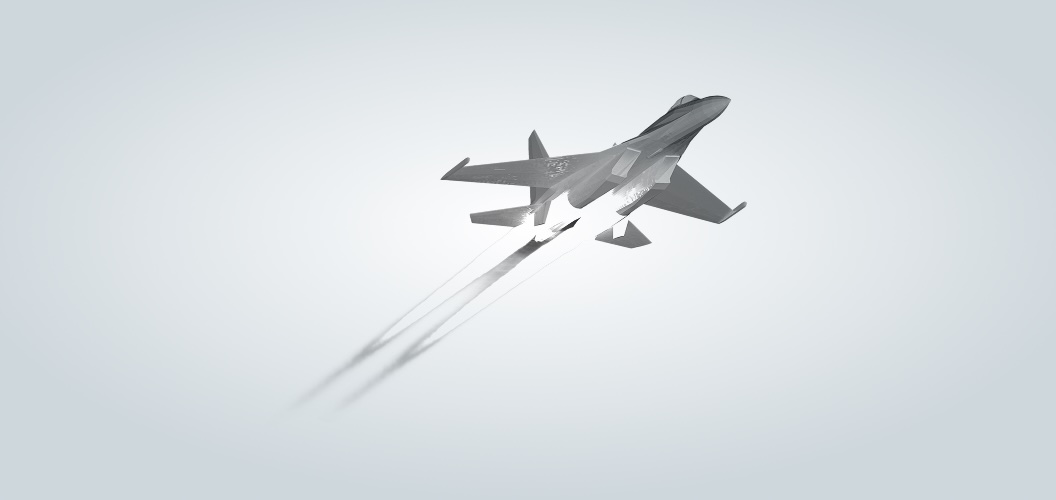
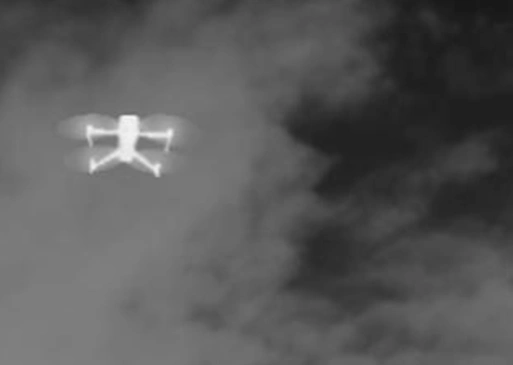
The image compositor takes the BRDF renderings and inserts them into a measured radiometrically calibrated background image. Once the target is inserted into the background image, operational effects (enhancements) such as rotor blur on propeller blades and exhaust plume signatures from engine exhaust can be applied. This enables targets to be inserted into a variety of background and terrain scenes, supporting improved realism for detection training and mission scenario analysis. This serves as a powerful stealth optimization tool, enabling detailed analysis and reduction of a UAV’s IR signature across operational environments.
Avionics and Electronics Cooling
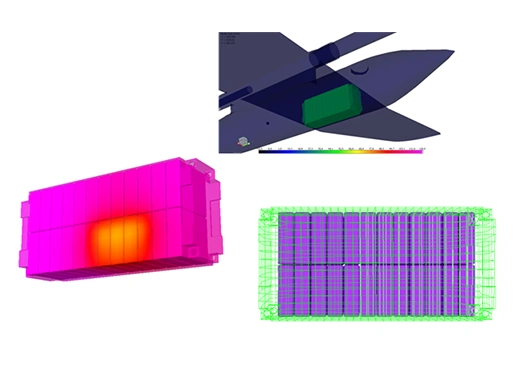
As UAV’s shrink in size while increasing in power, thermal management becomes a critical design constraint for internal electronics. Our tools allow for detailed Component-Level Analysis, simulating the thermal load of flight controllers, modems, and sensors. By identifying potential hotspots early in the design phase, engineers can optimize heat sink placement and airflow paths without the need for costly physical prototypes.
Aerodynamic Heating & High-Altitude Flight
At higher velocities and altitudes, aerodynamic heating becomes a significant factor in airframe integrity and sensor accuracy. MuSES incorporates specialized aerodynamic convection tools to simulate the heat generated from subsonic and supersonic airflow over airfoils and nose cones (or other stagnation points). This ensures that sensitive optical equipment remains calibrated and that structural composites are not compromised by localized temperature spikes during high-speed maneuvers.