

When Seconds Decide Survival: The Critical Role of Thermal Prediction
In directed energy warfare, seconds decide the outcome of an engagement. When your thermal model predicts target survival but field testing proves otherwise, the discrepancy doesn’t show up in a design review. It surfaces on the test range or, worse, in an operational theater. For defense programs developing or countering high-energy laser (HEL) weapon systems, the critical question isn’t whether you have thermal predictions. It’s whether you’ve validated those predictions against real-world data.
The Complexity Challenge: Why HEL Thermal Behavior Defies Simple Modeling
High energy laser effects concentrate enormous energy into pinpoint areas over extremely short durations. The result is a physics problem that spans multiple disciplines at once.
Accurate damage prediction requires resolving:
- Transient heat conduction through thin material layers
- Radiation exchange with the surrounding environment
- Convection effects that vary with target speed and altitude
- Fluctuations in HEL power, beam focus, beam aimpoint, and time on target
- All factors operating concurrently at high spatial resolution
The most challenging aspect lies upstream of any computational solver. Laser absorption is highly material-specific. Rates measured at room temperature in a controlled lab rarely match those that reproduce observed heating in operational scenarios. A ThermoAnalytics study confirmed what experimental teams have long known. Accurate, material-dependent laser absorption percentages are both critical and difficult to establish in advance. Every downstream prediction, from hull breach timing to battery thermal response, inherits this fundamental uncertainty.
Validation Through Rigorous Comparison: Laboratory Data as Ground Truth
The Norwegian Defence Research Establishment published laboratory measurements of thin metal samples under high-power laser irradiation. The samples included steel, aluminum, titanium, and brass. The ThermoAnalytics study used MuSES transient thermal and infrared simulation software to validate its results directly against those measurements.
The comparison evaluated two critical figures of merit:
- Temporal response at beam center: How rapidly the material heats
- Radial temperature distribution: How energy spreads laterally from the impact point
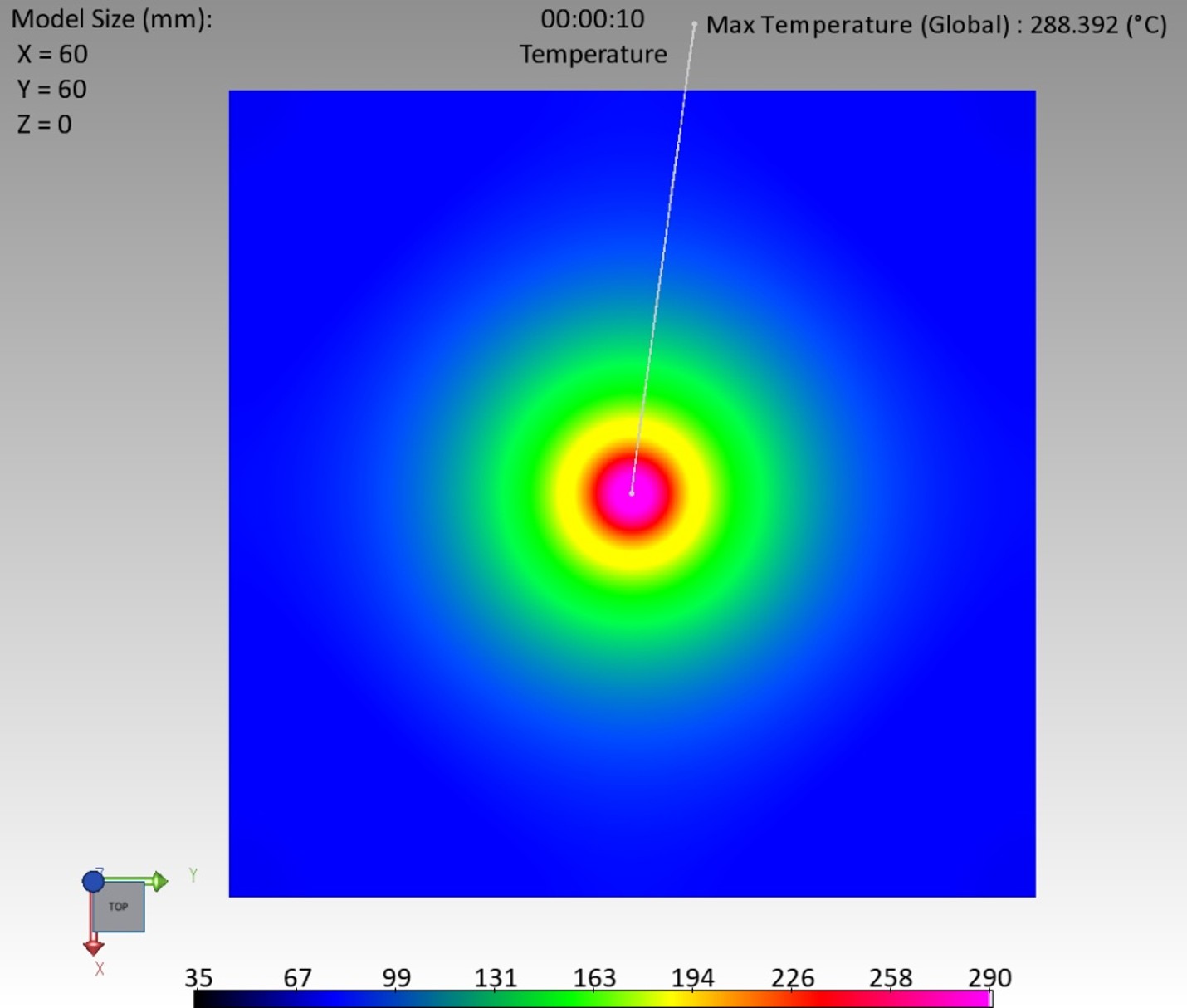
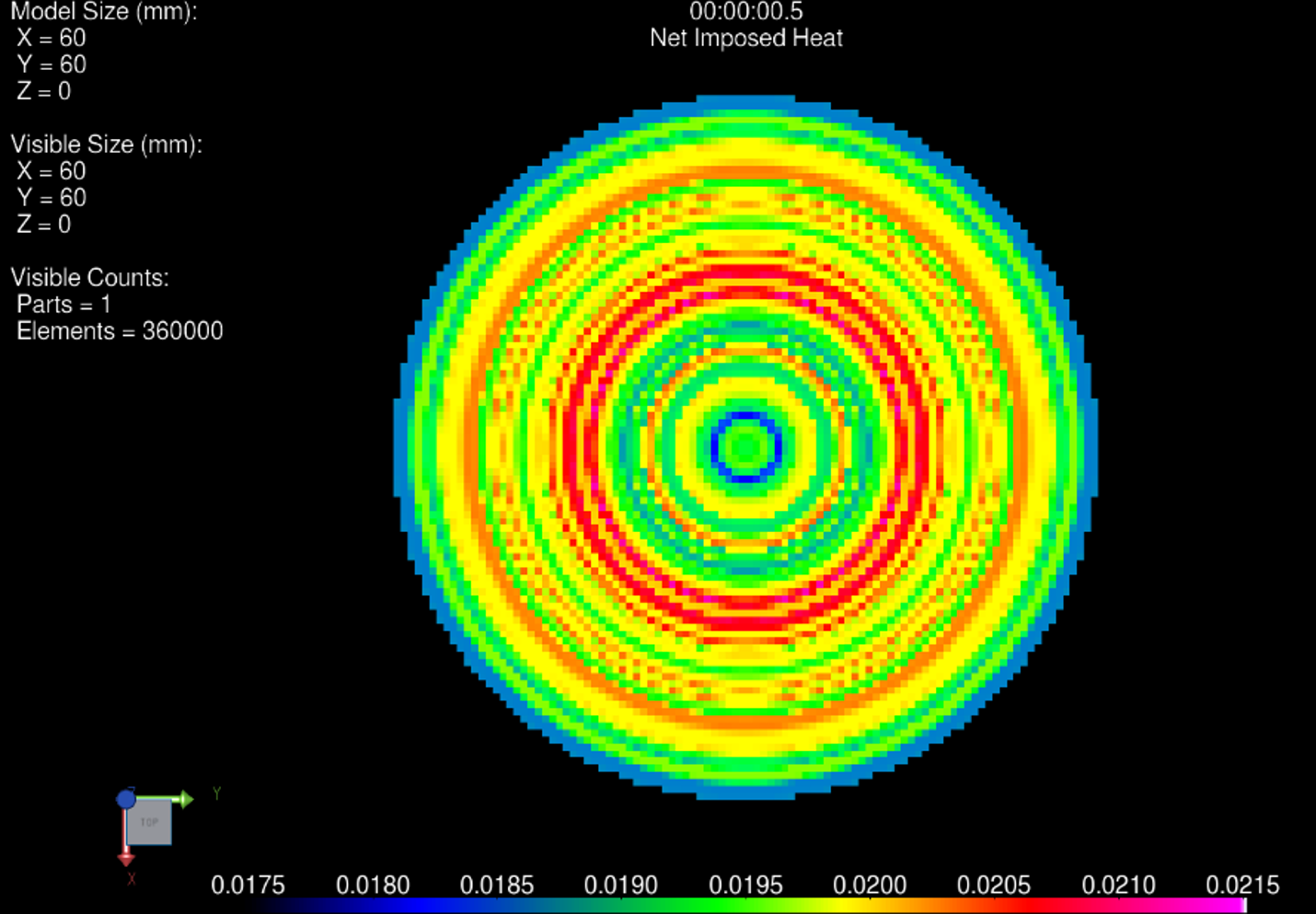
A model can accurately predict one metric while failing on the other. Across all tested samples, MuSES predictions closely tracked both the measured temporal and spatial responses. These predictions relied on absorption rates consistent with those the original experimental authors derived.
Methodological transparency matters. The simulations used constant values for laser absorption and thermal emissivity, with no temperature-dependent inputs. Nor did they model melting, ablation, or material removal. These simplifying assumptions came from the original experimental work. They proved largely appropriate for the tested conditions, including treating convection and radiation as non-dominant in that laboratory setup.
From Laboratory Coupons to Operational Assets: Real-World Complexity
Validation against test coupons is necessary but not sufficient to demonstrate real-world application. The flat plates in the test chamber experienced mainly laser-induced heating. They do not adequately represent the complex thermal environment that airborne assets face in an operational theater.
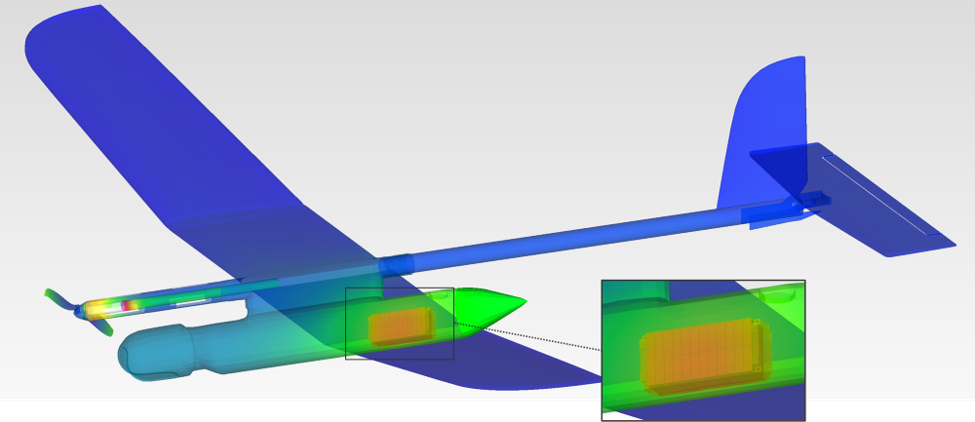
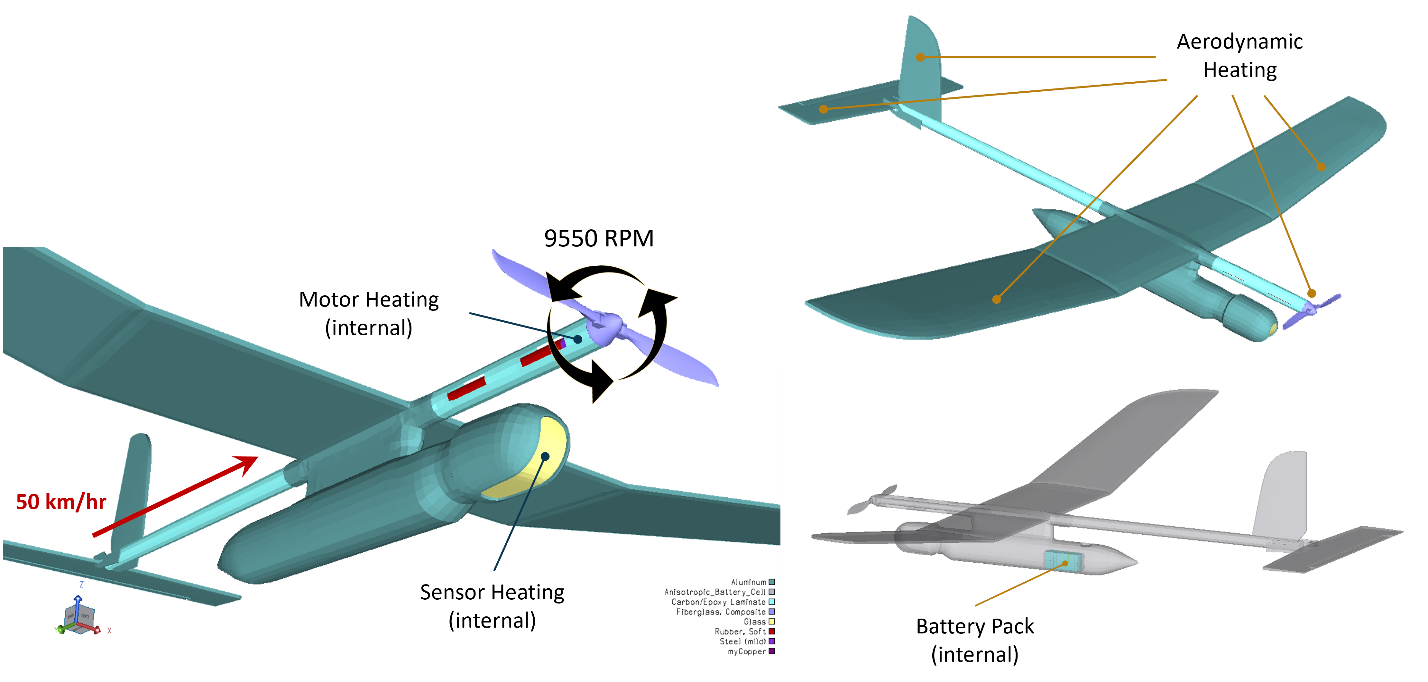
The study extended the validated methodology to a battery-powered UAV in flight, where the thermal landscape includes:
- Aerodynamic heating on propellers, wings, and tail surfaces
- Radiation exchange with cold upper atmosphere and terrain below
- Internal component heat generation
- Battery pack thermal-electrical coupling
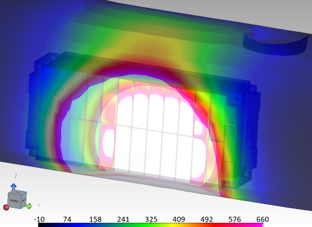
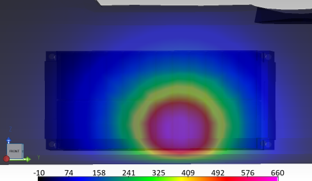
The simulation modeled a directed energy strike near the UAV’s battery enclosure. These additional real-world conditions affect the effectiveness of HEL weapon systems. The analysis tracked exterior hull temperature, battery enclosure temperature, and the onset and propagation of battery cell thermal runaway. The results show where simplified solvers fall short and why accurate predictions require a tool like MuSES.

Evaluating Countermeasures Before Hardware Commitment
The team then applied the validated model to a conceptual survivability enhancement package:
- Phase change material layer behind the aluminum exterior for additional thermal capacitance
- Carbon fiber layer for structural integrity at elevated temperatures
- Carbon fiber replacement for the aluminum battery enclosure
Predicted outcomes included meaningful delays in exterior breach and, critically, avoidance of battery thermal runaway within the evaluation window. The modifications demonstrate an evaluation methodology rather than a recommended design. That distinction matters. The value lies in a repeatable process for comparing candidate hardening concepts against relevant damage thresholds. Teams can make that comparison while concepts are still on paper, before tooling, integration, or program commitment.
Strategic Value: What Validated Thermal Simulations Deliver
Physical testing remains the gold standard for ground truth, and this work depends on that foundation rather than challenging it. The validation exercise exists only because researchers ran careful laboratory experiments and published their data.
Validated simulation approaches provide strategic reach. Engineers can analyze conditions that are difficult, expensive, or impossible to instrument. Examples include non-cooperative targets at altitude in turbulent atmospheres, or weapon systems too early in development for hardware testing. Laser power, beam profile, and dwell time become controlled parameters instead of expensive test campaign line items. Once analysis has narrowed the trade space, programs can focus physical test resources on the questions that truly require hardware.
Bridging the Gap: From Prediction to Performance
The risk in directed energy development isn’t a shortage of thermal predictions; it’s overconfidence in predictions never validated against measurements. This study addresses that gap. It shows that MuSES high-fidelity transient thermal modeling can reproduce published HEL test results in temporal and spatial domains. It then applies the same methodology to engagement scenarios of operational complexity.
Physical testing establishes what happens under defined conditions. Validation shows that a simulation can reproduce those measured responses. That provides a documented basis for applying the same physics to conditions that are difficult, expensive, or impractical to test. Engineers can explore a wider range of operational conditions and design trade spaces before hardware testing is practical or available.