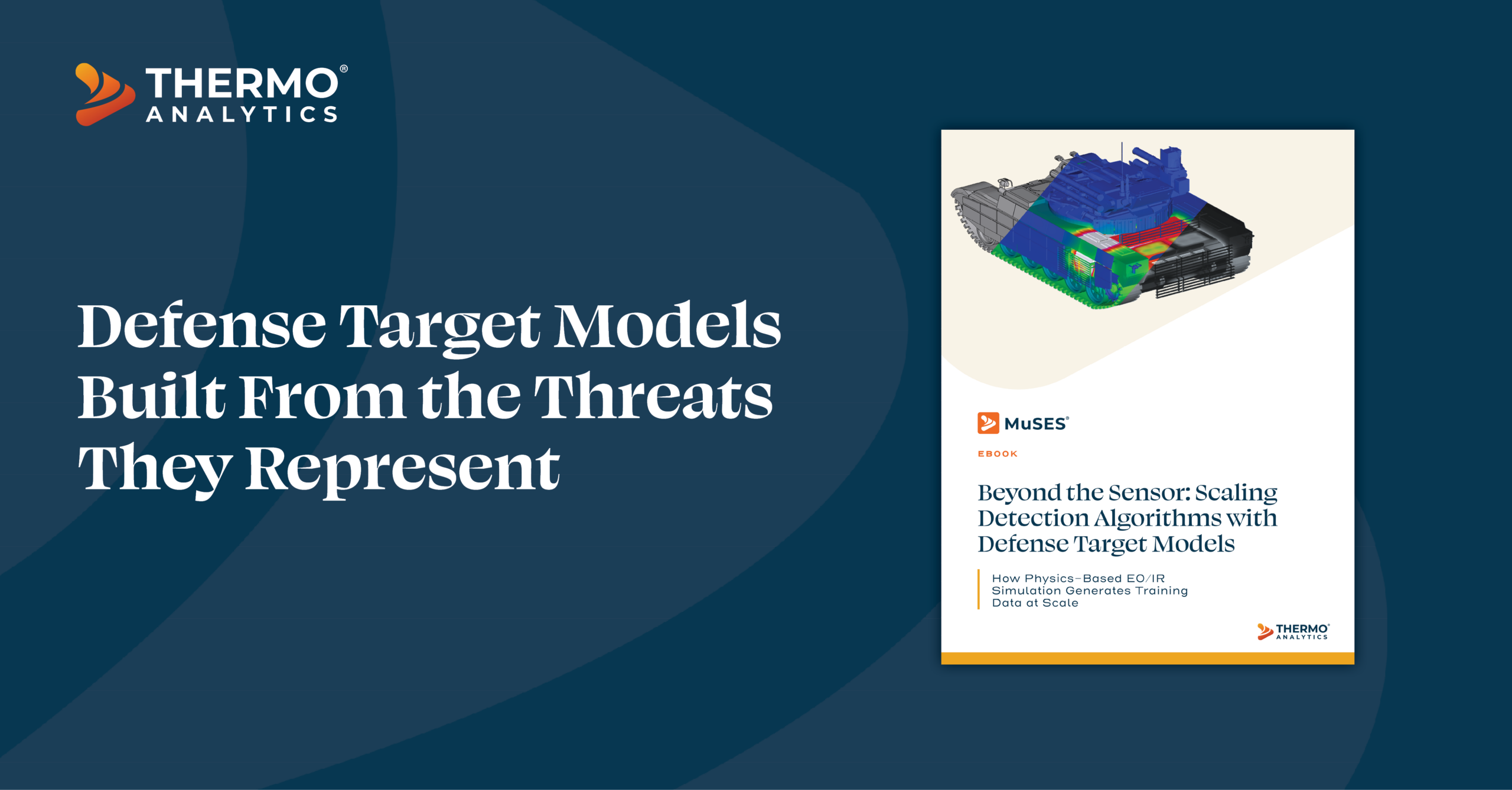

How Physics-Based EO/IR Simulation Generates Training Data at Scale
Generating synthetic EO/IR training data at scale increasingly decides whether a defense AI program ships on schedule. Field collection alone can’t produce the volume, variety, or edge-case coverage that modern detection algorithms need. Seasonal limits, denied platform access, and unsafe test conditions also widen that gap.
This eBook shows how physics-based EO/IR simulation closes it. Using MuSES alongside ThermoAnalytics’ Defense Target Model Library, engineering teams can generate synthetic EO/IR training data across the platforms, weather conditions, and mission profiles that measured field data alone can’t fully capture.
The same physics-based radiance modeling underlies development work across the defense sector for Automated Target Recognition, where an algorithm’s reliability depends entirely on the imagery used to train it. Rather than waiting on range access or weather windows, engineering teams can systematically vary target pose, sensor geometry, terrain, and atmospheric conditions to build datasets that reflect the full range of real-world detection scenarios.
Measured field data still sets the benchmark for final validation. What changes, though, is the volume and reach of everything that happens before it. This eBook maps that shift across four stages: defining physics inputs, computing thermal response, automating variation, and exporting machine-learning-ready outputs. As a result, engineering teams can reach scenarios that physical testing alone can’t safely or affordably cover.
What’s Inside
- Why physical collection alone can’t scale to modern machine learning requirements
- How physics-based synthetic imagery closes coverage gaps across weather, terrain, and sensor geometry
- Inside MuSES and the Defense Target Model Library’s physics-based architecture
- A four-step workflow for turning simulation into production-grade AI datasets
- Real mission applications, from automated target recognition to autonomous navigation
- A three-phase path to getting started