
On-Demand
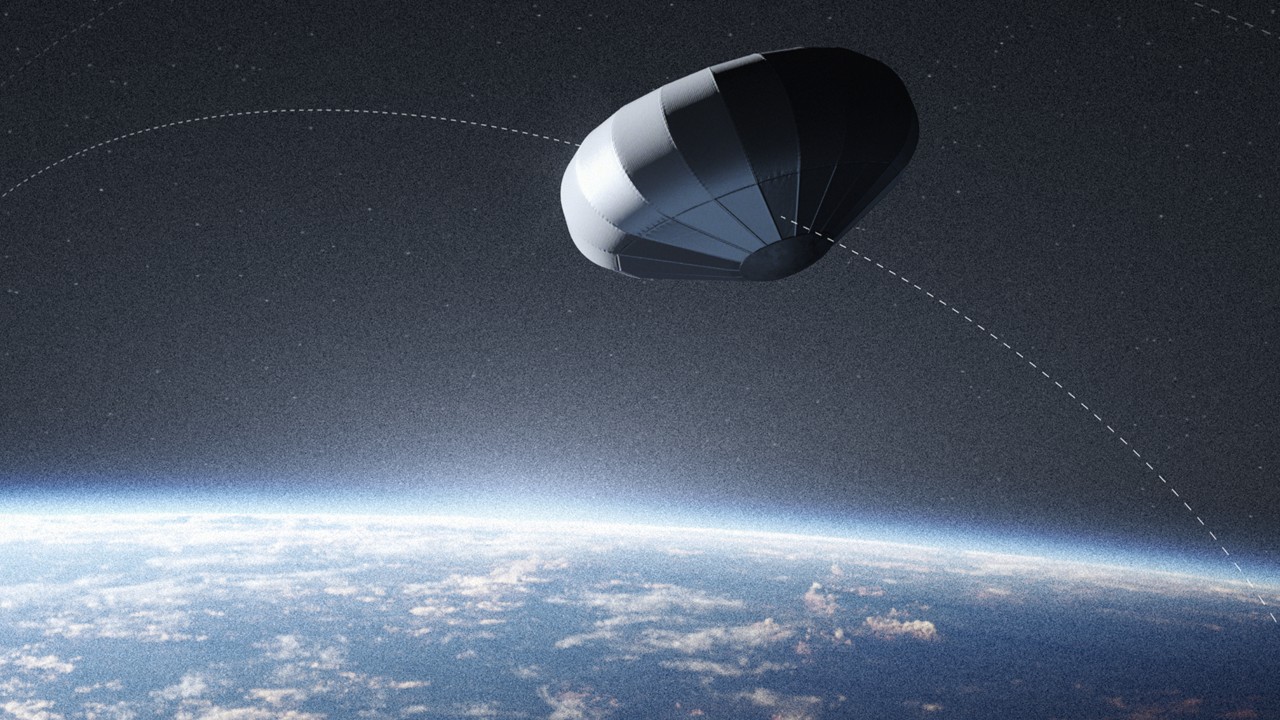
When a spacecraft transitions from the vacuum of Low Earth Orbit (LEO) to the searing heat of atmospheric re-entry, thermal management becomes critical. In fact, it’s often the difference between mission success and total loss. This on-demand webinar explores advanced transient thermal modeling techniques for high-velocity descent.
Featuring a real-world application of the Inflatable Atmospheric Decelerator (IAD) by ATMOS Space Cargo GmbH, we demonstrated how to predict extreme heating environments for reusable spacecraft. We walked through the 20-minute re-entry descent, spanning both hypersonic and supersonic regimes. Along the way, viewers gain insight into how TAITherm/MuSES and CoTherm accurately predict heat flux, surface temperatures, and internal payload conditions. This is achieved through automated setup of radiation, conduction, and convection, the core physics behind accurate atmospheric re-entry modeling.
Key Takeaways
- Precision Modeling: Use MuSES and CoTherm to accurately predict thermal conditions prior to re-entry.
- Trajectory Optimization: Learn how to optimize re-entry trajectories to minimize the thermal load on critical components.
- Payload Security: Ensure internal components remain within safe operating limits.
- Automated Physics: See how hypersonic and supersonic convective heating correlations are automatically applied to 3D geometry.
Who Should Watch
- Aerospace and Spacecraft Thermal Engineers seeking high fidelity in transient analysis.
- Systems Engineers tasked with return from orbit missions.
- Thermal Design Engineers developing automated workflows.
- Space Industry Professionals focused on LEO operation and payload return.
Whether you’re designing for a single high-stakes descent or building a repeatable process for reusable spacecraft, this webinar can help. It shows how physics-based atmospheric re-entry modeling shortens your development cycle and reduces risk.
Presenter

Logan Canull
Thermal/CFD Engineer
Logan Canull is a Thermal/CFD Engineer at ThermoAnalytics, Inc., where he supports research and development efforts focused on advancing the thermal modeling of orbital systems, unmanned aerial systems (UAS), and lithium-ion batteries. He joined ThermoAnalytics in 2022 after earning his B.S. in Mechanical Engineering from Michigan Technological University and completed his M.S. in Mechanical Engineering in 2023.