
On Demand Webinar
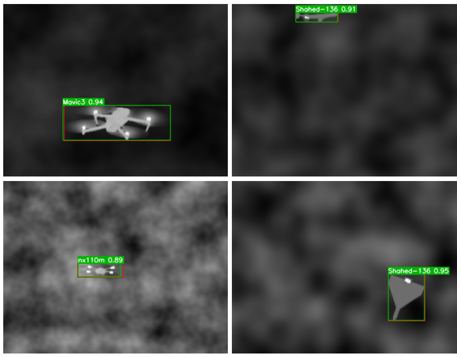
Achieving high performance in image-based drone detection requires robust algorithm training. That training relies on vast, diverse datasets for reliable statistical prediction. In the thermal infrared wavebands, obtaining such datasets from measured sources can be particularly challenging, especially when adversarial assets are the focus.
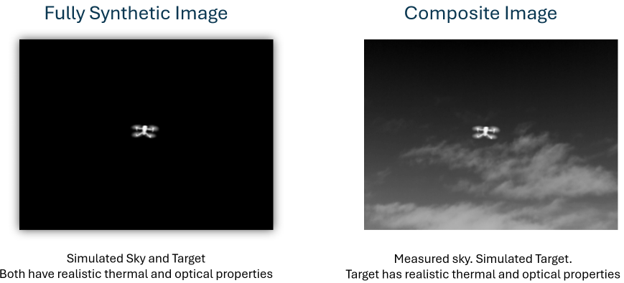
This presentation introduced an automated image-generation methodology using MuSES and CoTherm. Together, these tools supplement measured imagery with realistic synthetic scenes. We simulated commercial and military UAVs under varying environmental conditions, modeling complex heat sources such as batteries, gas engines, and aerodynamic heating. This process for generating large and diverse datasets is automated with CoTherm. It also includes options to incorporate the motion blur of spinning propeller blades and to create composite imagery by inserting synthetic targets into measured background scenes.
We concluded with a rigorous evaluation of YOLO11 and Faster R-CNN detection and recognition algorithms. Specifically, we analyzed how target resolution (quantified by number of pixels on target), background variation, and sensor slant ranges impact accuracy. This evaluation spanned both real and synthetic test sets.
Who Should Watch
This webinar is ideal for engineers, data scientists, researchers, and defense technologists working at the intersection of simulation, AI, and threat detection.
Presenter

Mark Klein
Senior Thermal and EO/IR ANalyst