

Cabin heating is one of the largest auxiliary energy draws in cold-weather EV operation. Every watt consumed by the heating system can reduce available driving range. Reducing that load, without sacrificing occupant comfort, is one of the most impactful steps an engineer can take to improve EV range. Radiant heating systems offer a more targeted solution by using radiant panels to warm occupants directly, enabling lower cabin air temperatures, reduced HVAC power demand, and improved passenger comfort.
How Radiant Heating Systems Work
To appreciate why radiant heating systems are so effective, it helps to review the three fundamental modes of heat transfer and understand how each contributes to cabin thermal management.
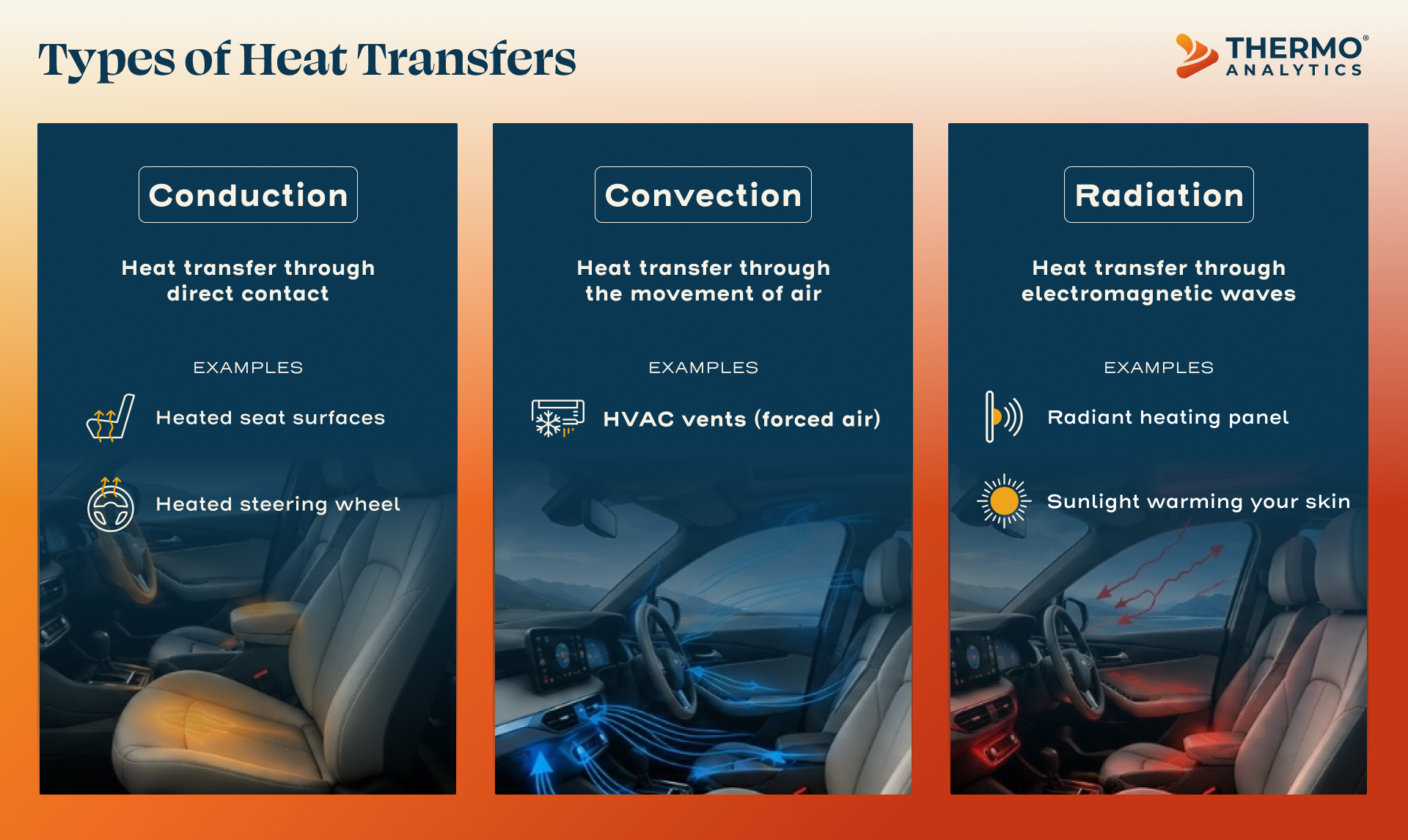
Conduction is the transfer of heat through direct contact. In a vehicle cabin, this includes warmth from a heated seat, steering wheel, or floor surface. Conduction is immediate and precise but limited to areas of direct contact.
Convection is the transfer of heat through fluid movement (in this case, air). Traditional automotive HVAC systems heat air at a central unit and distribute it through vents at high volume. While familiar and broadly effective, convective heating requires substantial energy to heat the full cabin air volume, takes time to deliver comfort, and creates drafts that can themselves reduce perceived comfort.
Radiation is the transfer of heat through electromagnetic waves, requiring neither direct contact nor moving air. Every warm surface emits thermal radiation. When absorbed by the human body, it creates a sensation of warmth regardless of surrounding air temperature, much like standing in sunlight on a cold winter day.
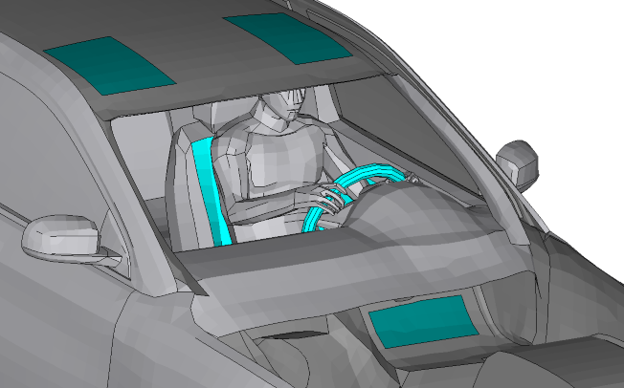
A car radiant heating system integrates heated panels into the vehicle interior at positions that maximize direct heat exchange with occupants. Common configurations include roof, console, and foot-well panels, creating a radiant envelope that warms occupants from multiple directions simultaneously.
Because radiant heating targets the occupant directly rather than the surrounding air volume, thermal comfort can be maintained at lower cabin air temperatures with far less energy than conventional HVAC approaches require.
How Radiant Panels Can Improve EV Range
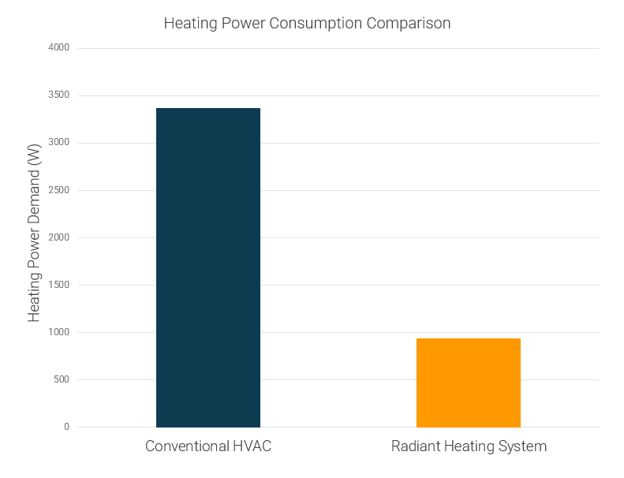
ThermoAnalytics’ simulation results illustrate the scale of the opportunity. Comparing a conventional forced-air HVAC system against a multi-zone radiant heating approach, the power demand difference was substantial:
- Conventional HVAC system: approximately 3,370 W to establish driver comfort
- Radiant heating system: approximately 940 W to achieve equivalent comfort
Because the human body responds to mean radiant temperature (MRT) as well as air temperature, comfort can be maintained at a lower cabin air setpoint when radiant panels are active, bypassing the need to heat the full cabin air mass before occupants feel warm.
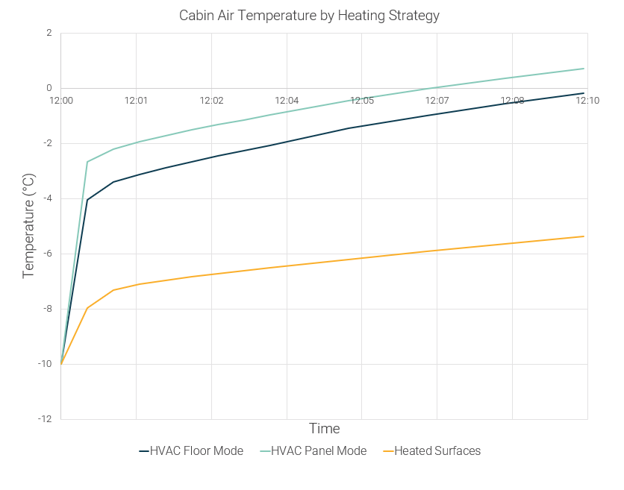
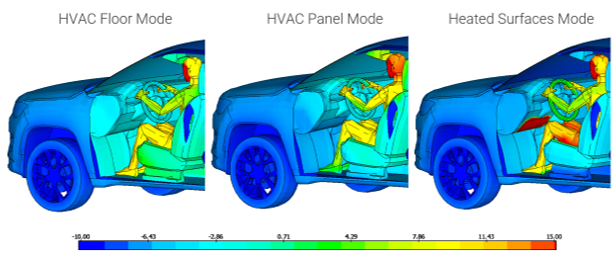
ThermoAnalytics compared three cabin heating strategies in simulation under cold-weather conditions: a conventional HVAC system distributing heat through floor vents (HVAC Floor Mode), an HVAC system distributing heat through panel vents (HVAC Panel Mode), and a targeted heated surfaces approach using radiant panels combined with a heated seat and steering wheel (Heated Surfaces Mode). The heated surfaces configuration achieved lower overall cabin air temperatures while meeting the same comfort targets.
How Radiant Panels Can Improve Occupant Comfort
Energy savings make a compelling engineering argument, but for drivers and passengers, comfort is the experience that matters. Radiant heating systems deliver meaningful improvements on this front as well, particularly during the warm-up period that defines the first minutes of a cold-weather drive.
With a conventional HVAC system, occupants face an inherent delay. High-volume airflow must heat a large cabin air mass before warmth is perceptible; in the meantime, passengers sit in contact with cold interior surfaces, experience low MRT, and endure drafts from air vents. This start-up discomfort is a frustration familiar to many EV drivers in cold climates.
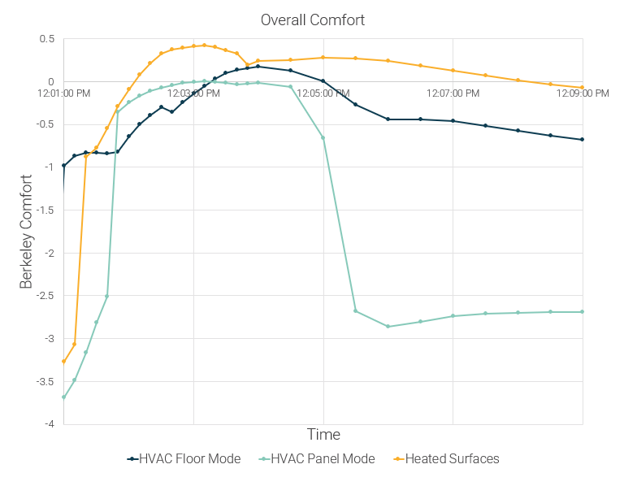
Radiant panels begin warming occupants and adjacent surfaces the moment they are energized. Simulation results, evaluated using the Berkeley Thermal Comfort Model, demonstrate this advantage quantitatively: from approximately 1 minute 30 seconds onward, the heated surfaces configuration maintained a higher overall comfort level than both HVAC modes throughout the drive cycle. The heated surfaces case was the only configuration to achieve and sustain a comfortable thermal state throughout the warm-up window.
Human thermal comfort is a multifactorial response. MRT, local skin temperatures, air velocity, humidity, clothing level, and metabolic rate all contribute. Because radiant heating directly elevates MRT and local surface temperatures, it influences the full thermal comfort equation, not just cabin air temperature.
Practical comfort benefits of radiant heating systems in vehicle applications include:
- Faster perceived warm-up from the first moments of operation
- Reduced discomfort from cold interior surfaces during cold starts
- Lower cabin air velocities and fewer drafts compared to forced-air systems
- More uniform thermal sensation across body segments
- Improved extremity comfort (hands, legs, and feet)
How ThermoAnalytics Tools Can Help
Designing and optimizing a radiant heating system is a complex, multi-physics engineering challenge, spanning thermal radiation, airflow, human physiology, and design trade-offs across a wide parameter space. ThermoAnalytics offers an integrated suite of simulation tools built for exactly this work.
TAITherm is the core environment for radiant heating system analysis. A key advantage is the automatic calculation of radiation view factors, critical for accurate radiant heat transfer in complex cabin geometries. Beyond radiation, TAITherm supports full-vehicle thermal analysis including transient warm-up, solar loading, and coupled thermal interactions between all cabin components.
RapidFlow enables efficient cabin airflow modeling and supports coupled convective and radiant cabin analysis. It captures how HVAC airflow mode, velocity, and temperature interact with the radiant heating configuration to shape the full occupant thermal environment.
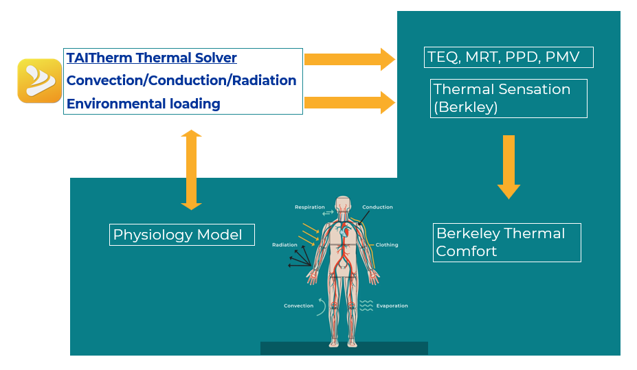
The Human Thermal Extension bridges the gap between surface temperatures and occupant experience by coupling a physiological human model with TAITherm’s thermal solver. It predicts thermal sensation and comfort response at the body-segment level, including Berkeley Comfort ratings, EHT, MRT, and PPD/PMV, throughout the drive cycle.
CoTherm is ThermoAnalytics’ process automation and optimization platform. For radiant heating system development, it enables systematic DOE studies and automated optimization workflows, exploring a wide range of design configurations to identify the best balance of comfort and energy efficiency.
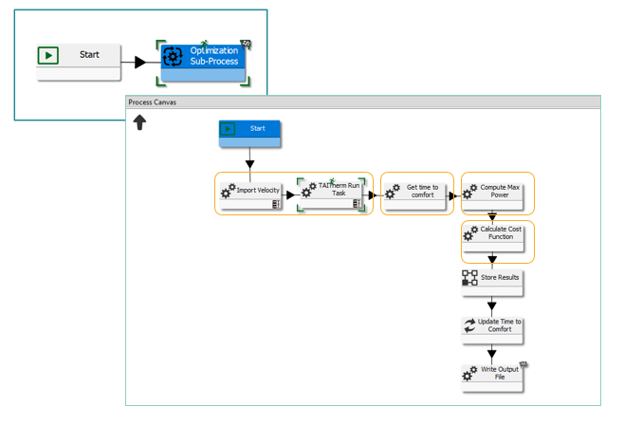
Together, TAITherm, RapidFlow, the Human Thermal Extension, and CoTherm form an integrated engineering workflow. Engineers can build a complete, high-fidelity cabin thermal model in TAITherm, enrich it with RapidFlow airflow data, evaluate occupant comfort responses with the Human Thermal Extension, and systematically optimize the design through CoTherm, all before a physical prototype exists.
Conclusion
Radiant heating systems provide a promising approach for improving both energy efficiency and passenger comfort in electric vehicles. By warming occupants directly through radiant panels, these systems can reduce HVAC energy consumption, extend winter driving range, and deliver faster, more uniform thermal comfort than traditional forced-air approaches. Combined with ThermoAnalytics’ simulation and optimization tools, engineers can accurately evaluate radiant heating strategies early in development and design vehicle cabins that are both more efficient and more comfortable for occupants.