
EO/IR Sensor Simulation
Satellite Thermal Management
Precision Engineering for Orbital Success
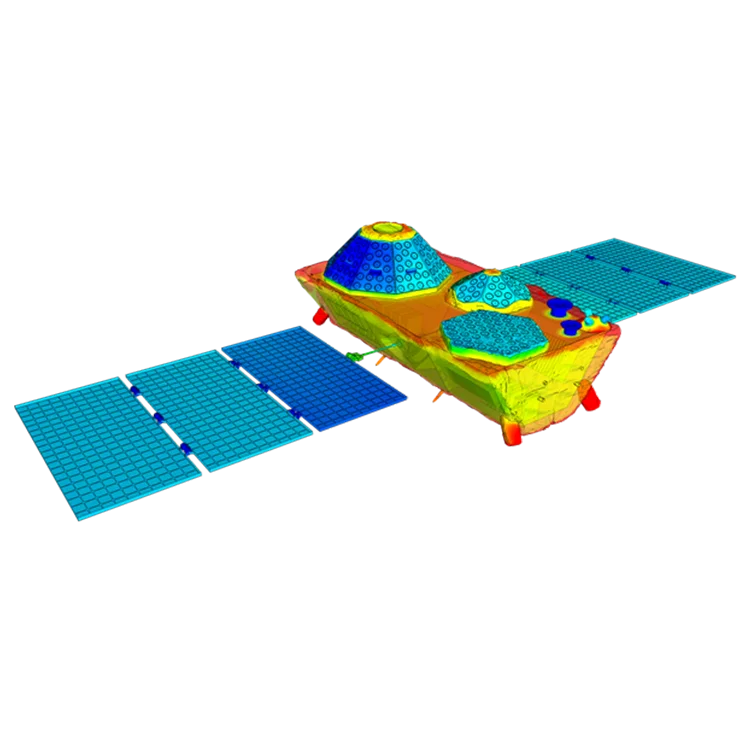
In the vacuum of space, thermal management is the boundary between mission success and catastrophic failure. As satellite designs trend toward smaller volumes packed with high-power components, such as CubeSats, thermal management becomes increasingly complex due to reduced radiative surface areas and lower thermal mass. ThermoAnalytics provides high-fidelity 3D transient thermal simulation tools, MuSES and CoTherm, to predict in-orbit temperatures and generate remotely sensed EO/IR images. Our solutions enable engineers to optimize spacecraft thermal control systems (TCS), managing the exaggerated temperature oscillations of sunlit and eclipsed orbit segments to keep critical electronics and battery cells within strict operational limits.
How It Works:
High-Fidelity Orbital Physics
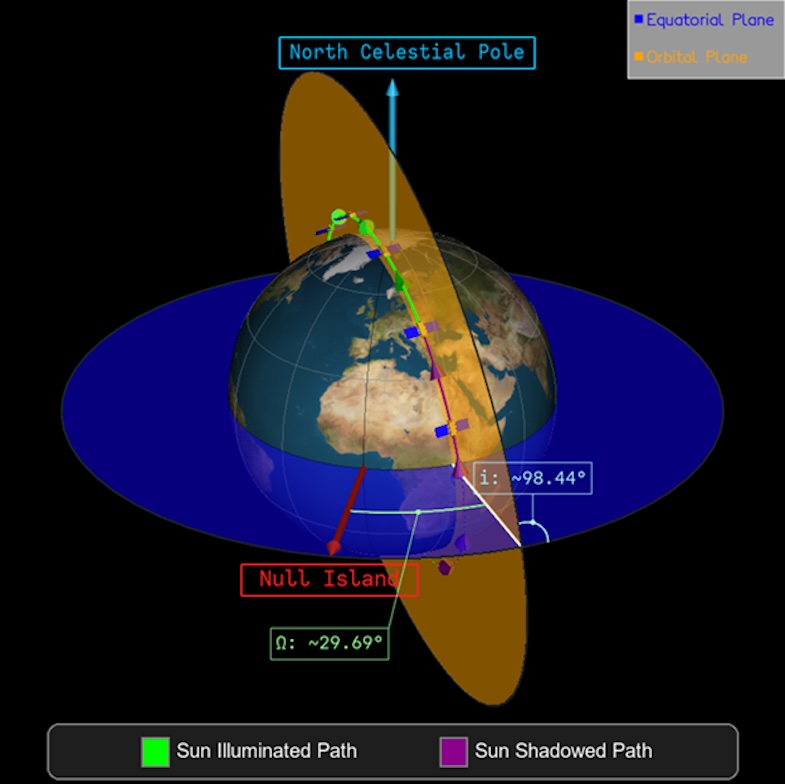
Our approach combines advanced orbit propagation with high-fidelity 3D thermal-electrical simulation to provide a holistic view of satellite performance throughout its mission. This coupled approach allows us to predict transient temperatures in orbit, considering solar power capture, electronic loads, and battery charging/discharging cycles.
The simulation process incorporates a satellite’s 3D surface/volume mesh populated with appropriate thermal material properties and active heat sources. A battery management system regulates charging and discharging based on charge status and available solar energy. PV module temperatures, solar incidence angle, and degradation determine solar power conversion efficiency, influencing the power available for electronics and battery charging. The simulation also accounts for declines in battery performance, such as reduced capacity and increased internal resistance, based on lifetime predictions.
Crucially, the orbital propagation tool provides essential boundary conditions to the transient thermal-electrical solver. Various visualizations are also created to confirm the model scenario as well as quickly testing different scenarios. This enables users to generate accurate thermal predictions with confidence, and verify that the results are directly representative of their specific operational scenario.
Our Methodology
- MuSES: A transient thermal-electrical and EO/IR simulation software that predicts heat transfer through radiation, conduction, and convection. It also integrates battery and PV panel models for coupled thermal-electrical analysis.
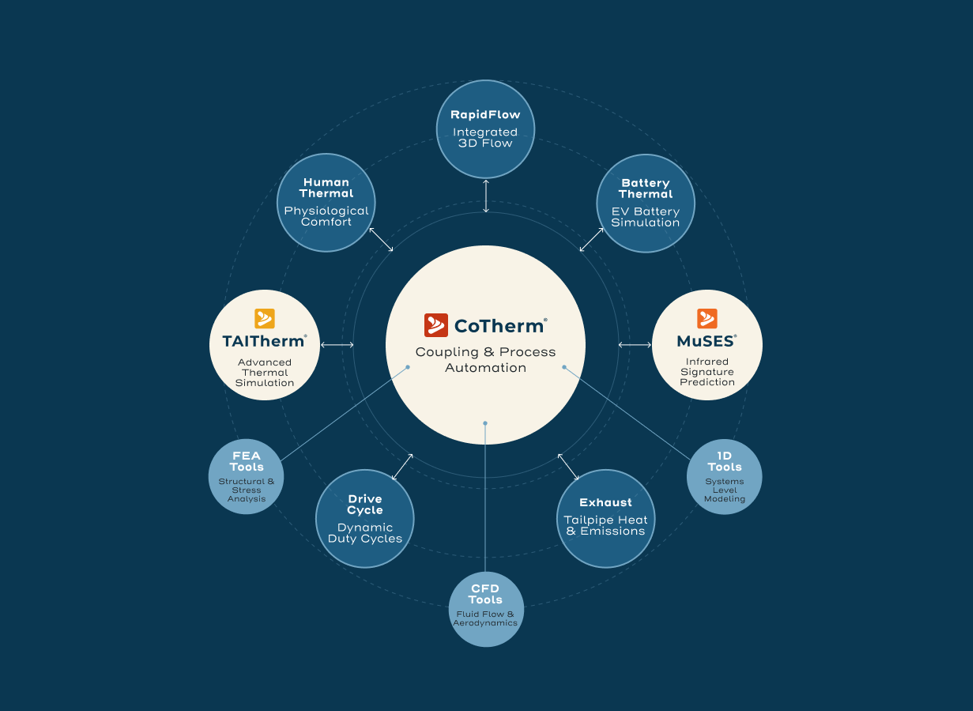
- CoTherm: A process automation software package that manages the coupled thermal-electrical simulations and exchanges data with other applications.
- Orbit Definition: Specifies the methodology used to define and propagate the orbital trajectory. The orbit may be characterized using orbital elements or a Two-Line Element (TLE) dataset for standard propagation models. Alternatively, a coordinate-based approach can be used by supplying a CSV file (FreeFlyer, etc.) containing time-stamped position data to define the orbital path.
- Battery Lifetime Prediction: A workflow that estimates changes in battery internal resistance and capacity based on temperature history and usage patterns.
- PV Radiation Degradation Analysis: A method for calculating proton and electron fluence and estimating the resulting degradation in PV panel efficiency.
Engineering Without Compromise
By integrating ThermoAnalytics into your design workflow, you transform thermal management from a reactive fix into a competitive advantage.
EO/IR Signature Prediction & Remote Sensing
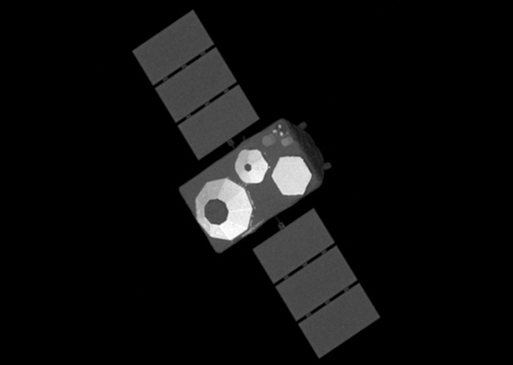
Beyond internal management, MuSES predicts how an orbiting satellite appears to remote sensors across the 0.4–20 micron spectrum (VIS to LWIR). This is essential for collision avoidance, tracking space debris, and defense observation. The software generates radiance images that include emitted energy and specular reflections, factoring in sensor-specific parameters like slant range, field of view, and realistic optical noise or blur.
Battery Management & Life Cycle Analysis
Satellite longevity depends on maintaining battery packs within narrow temperature ranges. Our simulation environment models the feedback loop where the thermal environment impacts electrical performance, and cell temperatures in turn affect the thermal state. By simulating successive orbits, engineers can refine thermal control strategies to stabilize battery health during peak power demands and discharge periods.
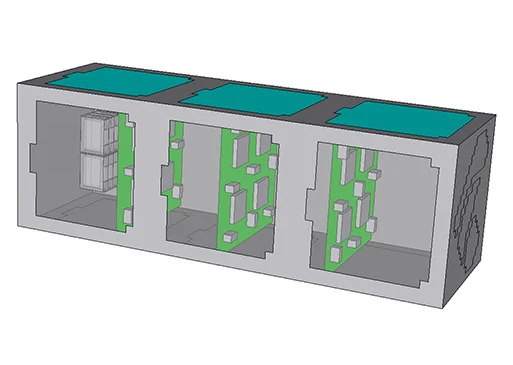
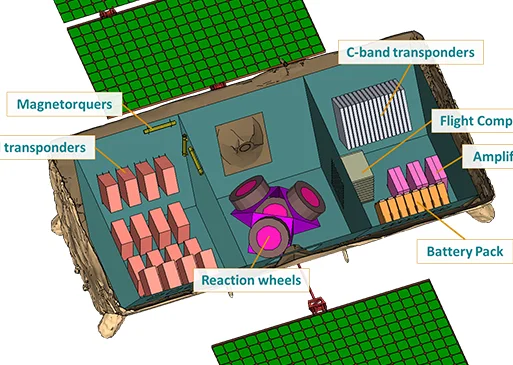
Detailed Payload & Multi-layer Insulation
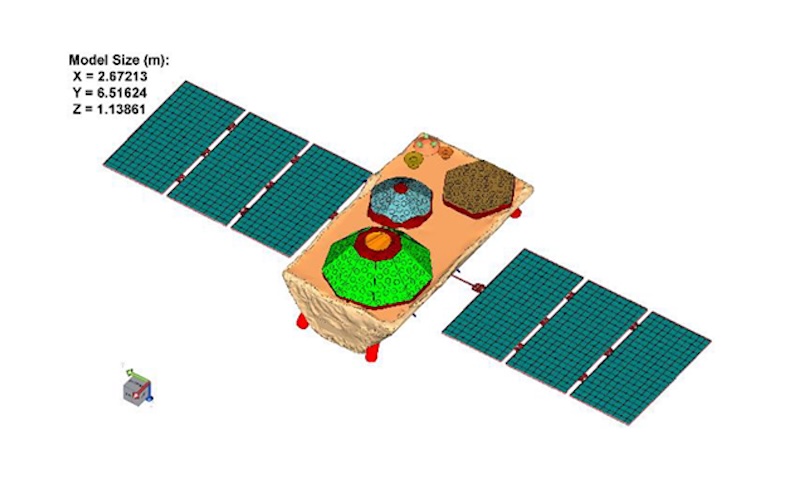
Modern satellites require granular modeling of internal components, including circuit boards, battery cells, and multi-layer insulation. Our tools support detailed 3D finite element geometry, allowing engineers to visualize temperature gradients through partial transparency. This ensures that every component, from high-power transmitters to delicate scientific instruments, is protected by an optimized thermal strategy that balances mass, volume, and performance.